“Treasure Box” All that the Father giveth Me shall come to Me; and Him that cometh to Me I will in no wise cast out. John 6:37 Father God, remind us of why we are the objects of Your constant love and care in Jesus Precious Name Amen.
“God’s Promise! We are His!” This is my command: Love each other. “If the world hates you, keep in mind that it hated me first. If you belonged to the world, it would love you as its own. As it is, you do not belong to the world, but I have chosen you out of the world. That is why the world hates you. Remember what I told you: ‘A servant is not greater than his master.’ If they persecuted me, they will persecute you also. If they obeyed my teaching, they will obey yours also. They will treat you this way because of my name, for they do not know the one who sent me. John 15:17-21 Whoever hates me hates my Father as well. John 15:23 The wicked shall perish; the godly shall stand. Proverbs 12:7 Surely Your goodness and love will follow me all the days of my life and I will dwell in the house of the Lord forever. Psalm 23:6
Chapter 33 This is a psalm of praise; it is probable that David was the penman of it, but we are not told so, because God would have us look above the penmen of sacred writ, to that blessed Spirit that moved and guided them. The psalmist, in this psalm, I. Calls upon the righteous to praise God. Psalm 33:1-22 Sing joyfully to the Lord, you righteous; it is fitting for the upright to praise him. Praise the Lord with the harp; make music to him on the ten-stringed lyre. Sing to him a new song; play skillfully, and shout for joy. For the word of the Lord is right and true; he is faithful in all he does. The Lord loves righteousness and justice; the earth is full of his unfailing love. By the word of the Lord the heavens were made, their starry host by the breath of his mouth. He gathers the waters of the sea into jars ; he puts the deep into storehouses. Let all the earth fear the Lord; let all the people of the world revere him. For he spoke, and it came to be; he commanded, and it stood firm. The Lord foils the plans of the nations; he thwarts the purposes of the peoples. But the plans of the Lord stand firm forever, the purposes of his heart through all generations. Blessed is the nation whose God is the Lord, the people he chose for his inheritance. From heaven the Lord looks down and sees all mankind; from his dwelling place he watches all who live on earth, he who forms the hearts of all, who considers everything they do. No king is saved by the size of his army; no warrior escapes by his great strength. A horse is a vain hope for deliverance; despite all its great strength it cannot save. But the eyes of the Lord are on those who fear him, on those whose hope is in his unfailing love, to deliver them from death and keep them alive in famine. We wait in hope for the Lord; he is our help and our shield. In him our hearts rejoice, for we trust in his holy name. May your unfailing love be with us, Lord, even as we put our hope in you. Father God, I thank You and praise Your holy name for all Your goodness and greatness to me and to all Your Children. Thank You that You have adopted me into your family and seated me together with Jesus Christ in heavenly places. Let me never forget Your loving-kindness oh Lord, may Your praise and thankfulness be forever on my lips, for You alone are worthy. I thank You, praise You and give You all the glory in Jesus Precious Name Amen. “Rejoice in the LORD, O ye righteous: for praise is comely for the upright.” (Psalm 33:1)
I would like to tell you, I have enjoyed my computer reading to me, so much. That when I have to read my study books, I can not obtain them on my computer to read to me. LOL! Guess being Philosophy a particular system of the Philosophical thought. They thought if I let the computer read to me. I would learn nothing and fall asleep. LOL!
I found this joke today: Who was the best financial Advisor in the bible? Noah was! He was floating stock, while everyone was in liquidation.
“Treasure Box “
Him that overcomes will I make a pillar in the temple of my God.
Revelation 3:12
Our Father, help us to hold fast to our faith in You. Give us strength and courage not to give up under pressure. I Jesus Precious Name Amen.
Learn to put aside your own desires so that you will become patient and godly, gladly letting God have His way. This will make possible the next step, which is for you to enjoy other people and to like them, and finally you will grow strong spiritually and become fruitful and useful to our Lord Jesus Christ. But anyone who fails to go after these additions to faith is blind indeed, or at least very short sighted, and has forgotten that God delivered him or her from the old life of sin so that now he can live a strong, good life for the Lord. So, dear brothers and sisters, work hard to prove that you really are among those God has called and chosen, and then you will never stumble or fall away. And God will open wide the gates of heaven for you to enter into the eternal kingdom of our Lord and Savior Jesus Christ.
1 Peter 1:6-11
The diligent man makes good use of everything he finds.
Psalm 32: The psalm describes the blessedness of forgiveness as no other does. happiness of the forgiven man (verses 1-2), the physical and psychological effects of unconfessed sin (verses 3-4), and the simple remedy of confession to obtain God’s forgiveness (verse 5). On this basis David can experience prayer. In the story of Psalm 32. David probably wrote Psalm 32 after he had slept with Bathsheba. She was the wife of Uriah. David sent Uriah to die in battle. The David married Bathsheba. For a while he did not ask God to forgive him. As a result he was very unhappy. Then he told God that he was sorry. Psalms 32:8 I will instruct thee and teach thee in the way which thou shalt go: I will guide thee with mine eye. Ver. 8. I will instruct thee and teach thee, No disgrace is it then for great men to be teachers of others. Amen! Of David. A “maskil: a person versed in Hebrew or Yiddish literature especially : a follower or adherent of the Haskalah movement .” Psalm 32:1-11 Blessed is the one whose transgressions are forgiven, whose sins are covered. Blessed is the one whose sin the LORD does not count against them and in whose spirit is no deceit. When I kept silent, my bones wasted away through my groaning all day long. For day and night your hand was heavy on me; my strength was sapped as in the heat of summer. Then I acknowledged my sin to you and did not cover up my iniquity. I said, “I will confess my transgressions to the LORD.” And you forgave the guilt of my sin. Therefore let all the faithful pray to you while you may be found; surely the rising of the mighty waters will not reach them. You are my hiding place; you will protect me from trouble and surround me with songs of deliverance. I will instruct you and teach you in the way you should go; I will counsel you with my loving eye on you. Do not be like the horse or the mule, which have no understanding but must be controlled by bit and bridle or they will not come to you. Many are the woes of the wicked, but the LORD’s unfailing love surrounds the one who trusts in him. Rejoice in the LORD and be glad, you righteous; sing, all you who are upright in heart!
Father God, there are many times when I have failed to listen to Your voice, gone my own way, and fallen flat on my face! Thank You and praise You that I can confess my faults to You, and that You are faithful and just to forgive all my sins and cleanse me from all unrighteousness. Help me to grow in grace, mature in the faith, and draw ever closer to You. Keep me alert to your instructions and directions for my life. Show me the path I should go, and guide me with Your eye always without a doubt. How awesome to know that You have scheduled every day of my life for my greater benefit. May I never stray from Your perfect path, and may my life be a godly witness and light of Jesus to others and a blessing to You. I thank You, praise You and give You all the glory in Jesus Precious Name Amen!
“I will instruct thee and teach thee in the way which thou shalt go: I will guide thee with mine eye.
Summary: Chapter 31: It is probable that David penned this psalm when he was persecuted by Saul; some passages in it agree particularly to the narrow escapes he had, at Keilah
(1 Samuel 23:13 ~So David and his men, about six hundred in number, left Keilah and kept moving from place to place. When Saul was told that David had escaped from Keilah, he did not go there.), then in the wilderness of Maon, when Saul marched on one side of the hill and he on the other, and, soon after, in the cave in the wilderness of En-gedi; but that it was penned upon any of those occasions we are not told.
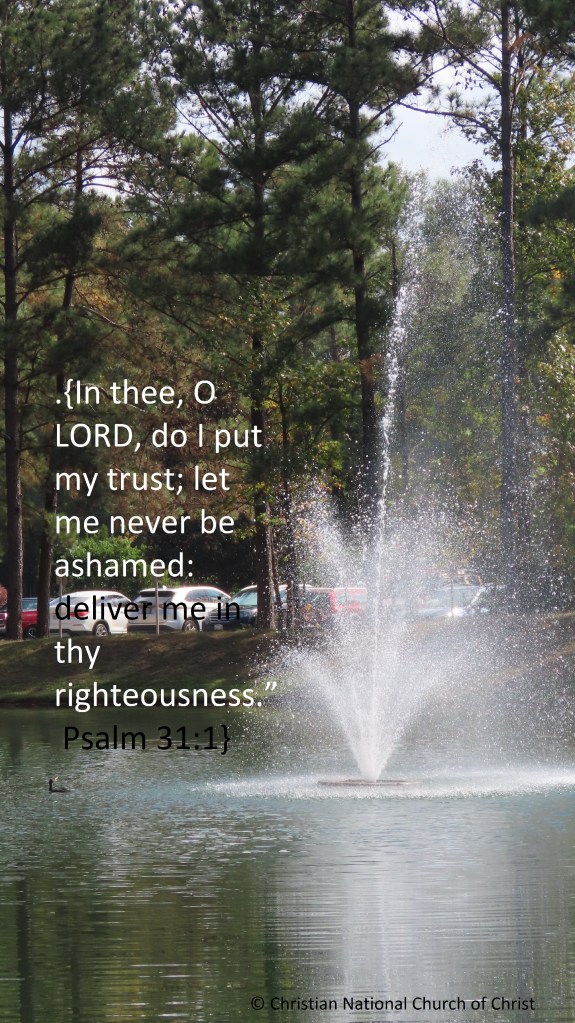
. {In thee, O LORD, do I put my trust; let me never be ashamed: deliver me in thy righteousness.” Psalm 31:1}
Psalm Chapter 31:1-24 For the director of music. A psalm of David. In you, LORD, I have taken refuge; let me never be put to shame; deliver me in your righteousness. Turn your ear to me, come quickly to my rescue; be my rock of refuge, a strong fortress to save me. Since you are my rock and my fortress, for the sake of your name lead and guide me. Keep me free from the trap that is set for me, for you are my refuge. Into your hands I commit my spirit; deliver me, LORD, my faithful God. I hate those who cling to worthless idols; as for me, I trust in the LORD. I will be glad and rejoice in your love, for you saw my affliction and knew the anguish of my soul. You have not given me into the hands of the enemy but have set my feet in a spacious place. Be merciful to me, LORD, for I am in distress; my eyes grow weak with sorrow, my soul and body with grief. My life is consumed by anguish and my years by groaning; my strength fails because of my affliction,and my bones grow weak. Because of all my enemies, I am the utter contempt of my neighbors and an object of dread to my closest friends— those who see me on the street flee from me. I am forgotten as though I were dead; I have become like broken pottery. For I hear many whispering, “Terror on every side!” They conspire against me and plot to take my life. But I trust in you, LORD; I say, “You are my God.” My times are in your hands; deliver me from the hands of my enemies, from those who pursue me. Let your face shine on your servant; save me in your unfailing love. Let me not be put to shame, LORD, for I have cried out to you; but let the wicked be put to shame and be silent in the realm of the dead. Let their lying lips be silenced, for with pride and contempt they speak arrogantly against the righteous. How abundant are the good things that you have stored up for those who fear you, that you bestow in the sight of all, on those who take refuge in you. In the shelter of your presence you hide them from all human intrigues; you keep them safe in your dwelling from accusing tongues. Praise be to the LORD, for he showed me the wonders of his love when I was in a city under siege. In my alarm I said, “I am cut off from your sight!” Yet you heard my cry for mercy when I called to you for help. Love the LORD, all his faithful people! The LORD preserves those who are true to him, but the proud he pays back in full. Be strong and take heart, all you who hope in the LORD.
Father God, just like David I have taken my refuge in You and I trust in Your sure Word and never ever failing promises. For You are righteous. I believe Father God, that You will deliver me out of the difficulties I am facing today and give me the grace to get through. {In thee, O LORD, do I put my trust; let me never be ashamed: deliver me in thy righteousness.” Psalm 31:1} I thank You, praise You and give You all the glory in Jesus Precious Name Amen.
I can remember reducing tension in my children’s disagreements sometimes. I’d feel good that it all worked out. Sometimes I had to let it go and watch how they worked it out. Even if I didn’t get any credit for them working it out, not causing no more tension and them going back to having fun. Best part of being a mom is seeing the unity and resect they held for each other. “Speaking up for what is right was my motto for being mom. Want the to grow up as a person who is pure of heart sees goodness and purity in everything. { To the pure, all things are pure, but to those who are corrupted and do not believe, nothing is pure. In fact, both their minds and consciences are corrupted. They claim to know God, but by their actions they deny him. They are detestable, disobedient and unfit for doing anything good. Titus 1:15-16} But as for you, speak up for the right living that goes along with true Christianity. Titus 2:1 My willingness to go with God’s desires and not my own. It offers a good feeling of knowing you could help someone else. {Cast your cares on the Lord and He will sustain you; He will never let the righteous be shaken. Psalm 55:22 When you are doing the right thing . It doesn’t matter whether others approve or they don’t. God promises when we live for Him, He will present on us God-given faith, confidence, conviction and peace of mind.
Father God, I thank You and praise You, that no matter what dangers and evils threaten me, and no matter what terrors and difficulties come near me, that I may cast all my burdens upon You, knowing that You will sustain and strengthen me. Knowing that in Jesus I need never be shaken by terrors or threats. I praise You God that greater is He that is in me, than he that is in the world. I love You, I thank You, praise You and give You all the glory in Jesus Precious Name Amen.
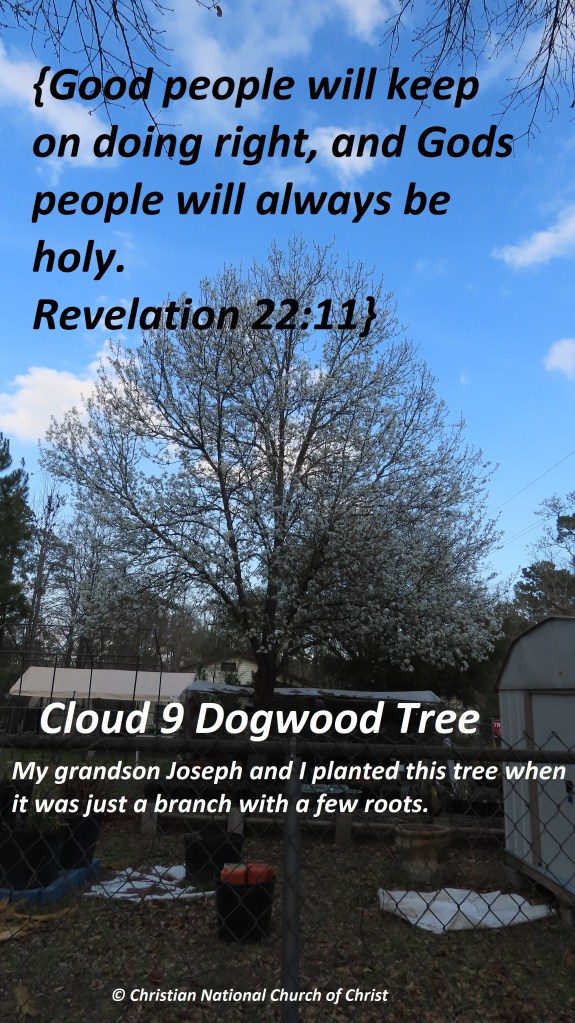
{Good people will keep on doing right, and Gods people will always be holy. Revelation 22:11}
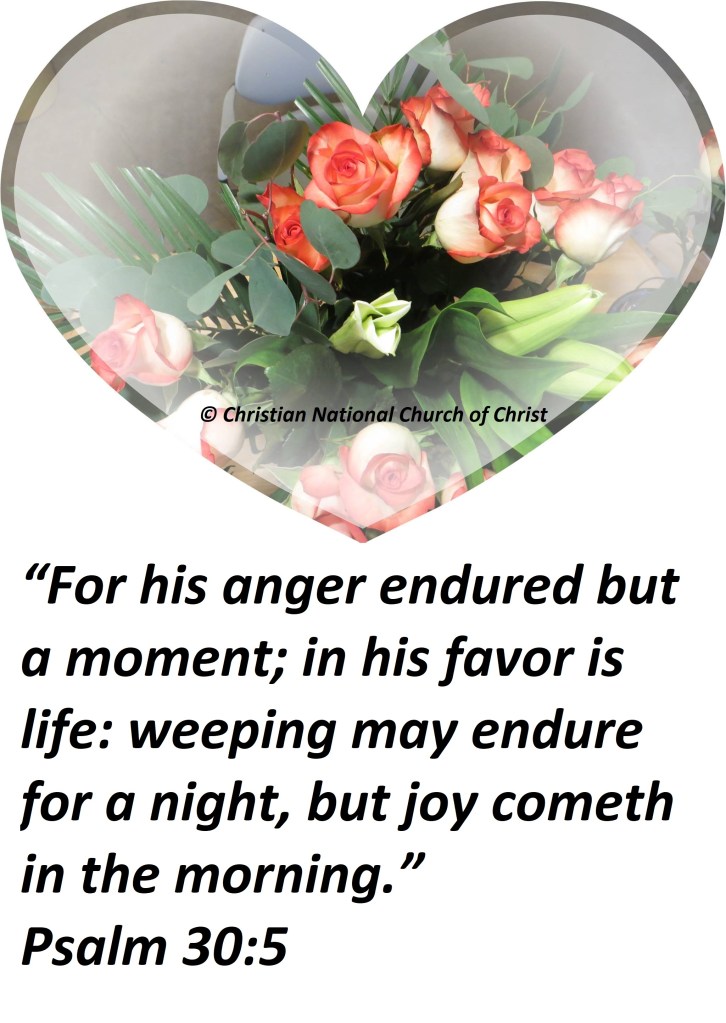
Psalm 30 is a praise psalm. But as we study through this psalm it might sound sort of like a “lament: a passionate expression of grief or sorrow.” We’ll see David relate how his own pride seemed to bring God’s fearful chastening – which he says almost killed him. But the Lord was merciful and so David praises him for that mercy. Psalm 30:1-12 A psalm. A song. For the dedication of the temple. Of David. I will exalt you, LORD, for you lifted me out of the depths and did not let my enemies gloat over me. LORD my God, I called to you for help, and you healed me. You, LORD, brought me up from the realm of the dead; you spared me from going down to the pit. Sing the praises of the LORD, you his faithful people; praise his holy name. For his anger lasts only a moment, but his favor lasts a lifetime; weeping may stay for the night, but rejoicing comes in the morning. When I felt secure, I said, “I will never be shaken.” LORD, when you favored me, you made my royal mountain stand firm; but when you hid your face, I was dismayed. To you, LORD, I called; to the Lord I cried for mercy: “What is gained if I am silenced, if I go down to the pit? Will the dust praise you? Will it proclaim your faithfulness? Hear, LORD, and be merciful to me; LORD, be my help.” You turned my wailing into dancing; you removed my sackcloth and clothed me with joy, that my heart may sing your praises and not be silent. LORD my God, I will praise you forever. Father God, I praise and thank You for Your loving-kindness and long-suffering towards me and all Your children. Thank You that no matter what difficulty, suffering, pain and even good stuff, I may go through in this life, that weeping will be replaced with laughter and pain with joy. I thank You that I get to see prayers being answered, this does fill my heart with joy. I thank You, praise You and give You all the glory in Jesus Precious Name, Amen.
“For his anger endured but a moment; in his favor is life: weeping may endure for a night, but joy cometh in the morning.” (Psalm 30:5)
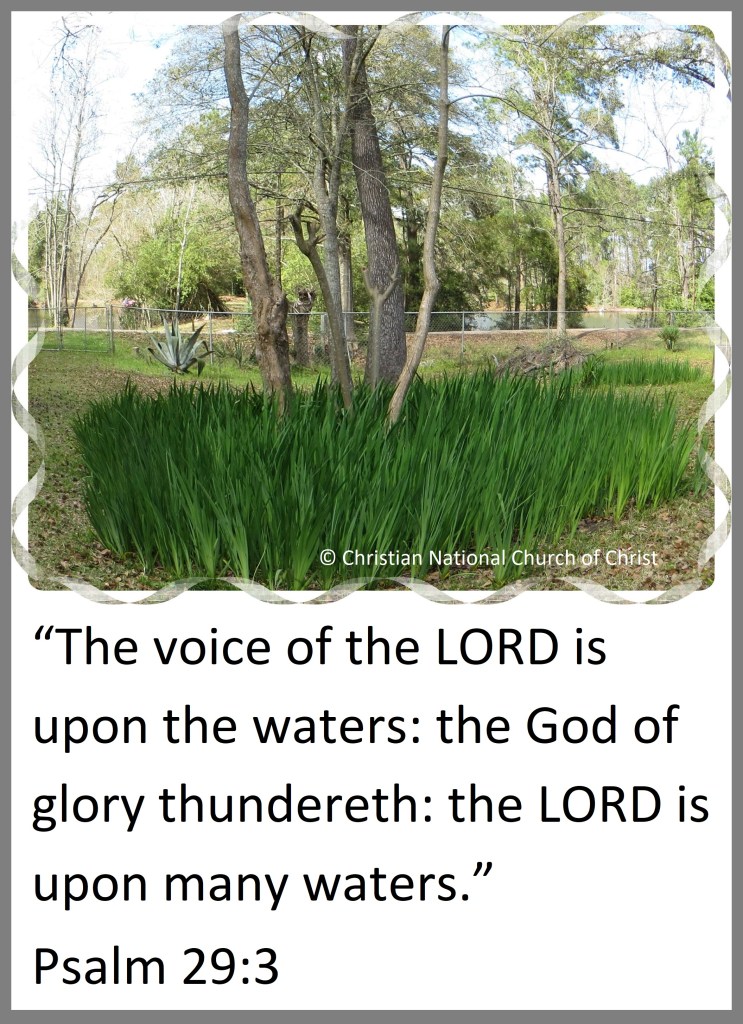
Summary: Psalm 29 is a praise psalm in which the Lord is receiving praise for being the God of the storm. David is urging his fellow-Israelites to stop attributing the power and benefits of storms to the false god Baal. Instead, he urges them to worship the Lord alone. Psalm 29:1-11 A psalm of David. Ascribe to the LORD, you heavenly beings, ascribe to the LORD glory and strength. Ascribe to the LORD the glory due his name; worship the LORD in the splendor of his holiness. The voice of the LORD is over the waters; the God of glory thunders, the LORD thunders over the mighty waters. The voice of the LORD is powerful; the voice of the LORD is majestic. The voice of the LORD breaks the cedars; the LORD breaks in pieces the cedars of Lebanon. He makes Lebanon leap like a calf, Sirion like a young wild ox. The voice of the LORD strikes with flashes of lightning. The voice of the LORD shakes the desert; the LORD shakes the Desert of Kadesh. The voice of the LORD twists the oaksand strips the forests bare. And in his temple all cry, “Glory!” The LORD sits enthroned over the flood; the LORD is enthroned as King forever. The LORD gives strength to his people; the LORD blesses his people with peace.
“The voice of the LORD is upon the waters: the God of glory thundered: the LORD is upon many waters.” (Psalm 29:3)
Father God, there are so many examples of Your great glory and majesty everywhere I go. Still, You are interested in me, Your child. Help me be aware through my hearing of Your voice, that I may live humbly and walk wisely before You, in spirit and truth. I thank You and praise You in Jesus Precious Name Amen.
Psalm 28 Book Psalm of David summary: Psalm 28 is the 28th psalm from the Book of Psalms. This psalm “is a prayer: expostulating with Yahweh for abandoning His people in peril of death, and crying aloud for help, with hands uplifted towards the holy shrine; urging that He discriminate between them and their enemies, visiting the latter with retribution for their deeds; blessing Yahweh{Yahweh in Hebrew Is a Relational God. Yahweh is only used in the Bible when the author is talking about God’s personal relationship with his people. A great example of this is Psalm 19. The author talks in the first 6 verses about Elohim (another name for God in Hebrew) and his relationship with the material world.} , the strength and shield, and rejoicing in Him as the refuge for king and people. Glosses give a reason for the imprecation upon enemies and a liturgical petition for salvation.” Psalm 28:1-9 To you, LORD, I call; you are my Rock, do not turn a deaf ear to me. For if you remain silent, I will be like those who go down to the pit. Hear my cry for mercy as I call to you for help, as I lift up my hands toward your Most Holy Place. Do not drag me away with the wicked, with those who do evil, who speak cordially with their neighbors but harbor malice in their hearts. Repay them for their deeds and for their evil work; repay them for what their hands have done and bring back on them what they deserve. Because they have no regard for the deeds of the LORDand what his hands have done, he will tear them down and never build them up again. Praise be to the LORD, for he has heard my cry for mercy. The LORD is my strength and my shield; my heart trusts in him, and he helps me. My heart leaps for joy, and with my song I praise him. The LORD is the strength of his people, a fortress of salvation for his anointed one. Save your people and bless your inheritance; be their shepherd and carry them forever.
Father God, , thank You that we can gain comfort and joy not jusst me but, all Your children gain from Your precious Word knowledge, and I thank You that You are my strength and my Shield. My heart trusts in You, and I praise and thank You for the help and comfort I received, through faith in Christ Jesus my Saviour. Thank You that Your ear is ever open to the cries and the cry of Your people. Help me take every thought and look to Jesus Christ in prayer from my heart, when circumstances arise that would otherwise overwhelm me and cause me to fear. The joy of the Lord is my strength {Nehemiah 8:10}, therefore my heart has Jubilation in grateful thanks and eternal praise, in Jesus Precious Name Amen.
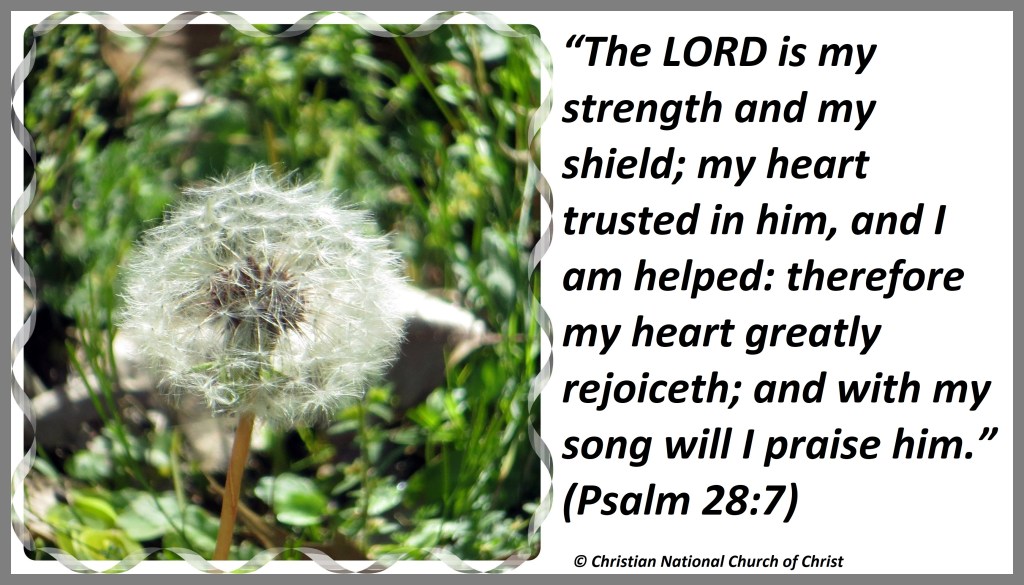
“The LORD is my strength and my shield; my heart trusted in him, and I am helped: therefore my heart greatly rejoices; and with my song will I praise him.” (Psalm 28:7)
Posted on
“A Psalm of Fearless Trust In God” Summary of: Psalm 27 is powerful and meaning light is God and we need to hide under light and put confident in God, our strength is God and God is the lifters of our head and protection, thank you Jesus for what you are doing for us ..thank you.. I thank my God, my Light and Salvation and My Life. Psalm 27:1-14: The LORD is my light and my salvation— whom shall I fear? The LORD is the stronghold of my life, of whom shall I be afraid? When the wicked advance against me to devour me, it is my enemies and my foes who will stumble and fall. Though an army besiege me, my heart will not fear; though war break out against me, even then I will be confident. One thing I ask from the LORD, this only do I seek: that I may dwell in the house of the LORD all the days of my life, to gaze on the beauty of the LORD and to seek him in his temple. For in the day of trouble he will keep me safe in his dwelling; he will hide me in the shelter of his sacred tent and set me high upon a rock. Then my head will be exalted above the enemies who surround me; at his sacred tent I will sacrifice with shouts of joy; I will sing and make music to the LORD. Hear my voice when I call, LORD; be merciful to me and answer me. My heart says of you, “Seek his face!” Your face, LORD, I will seek. Do not hide your face from me, do not turn your servant away in anger; you have been my helper. Do not reject me or forsake me, God my Savior. Though my father and mother forsake me, the LORD will receive me. Teach me your way, LORD; lead me in a straight path because of my oppressors. Do not turn me over to the desire of my foes, for false witnesses rise up against me, spouting malicious accusations. I remain confident of this: I will see the goodness of the LORD in the land of the living. Wait for the LORD; be strong and take heart and wait for the LORD.
Father God, too often my old sin nature comes to mind. Let the powerful mind You gave me as a gift, never stop abiding in You and resting on Your promises. Help me to learn to wait on You and to be of good courage, knowing that You are in perfect control of my life. That all I am called to do is to quietly, peacefully and prayerfully wait on You to act on my behalf and to confidently wait on You with prayer, petition, worship and a heart of thanksgiving, praise and giving You all the glory in Jesus Precious Name Amen.
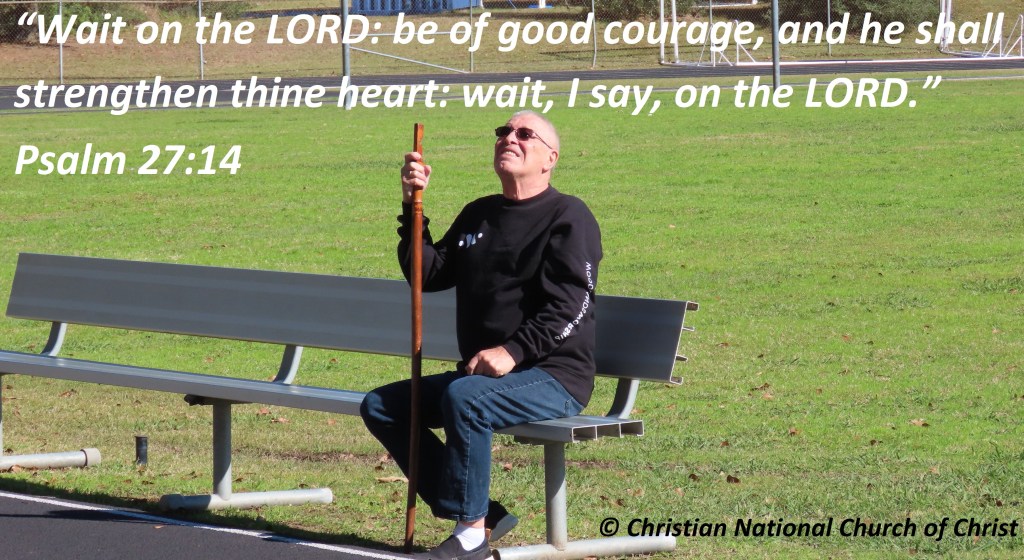
“Wait on the LORD: be of good courage, and he shall strengthen thine heart: wait, I say, on the LORD.” (Psalm 27:14)

 "Only Life Changes"