Father God, my mind is open to Your Thoughts, and closed today to every thought but Yours. I rule my mind, and offer it to You. Accept my precious gift, for it is Yours to me. Amen and Amen.
07/13/2017 OCM-83656272 {Member of ULC 9/23/22
7545620-0414Susan Ruth Robertson202004377}
Question: What will characterize the reign of the Messianic King? Answer: It reads in Isaiah 11:6-7 NIV> The wolf will live with the lamb, the leopard will lie down with the goat, the calf and the lion and the yearling together; and a little child will lead them. The cow will feed with the bear, their young will lie down together, and the lion will eat straw like the ox. It reads in Isaiah 32:1-2 NIV> See, a king will reign in righteousness and rulers will rule with justice. Each one will be like a shelter from the wind and a refuge from the storm, like streams of water in the desert and the shadow of a great rock in a thirsty land.
Question: What is Isaiahs’s vision of the Messianic King?
Answer: The people walking in darkness have seen a great light; on those living in the land of deep darkness a light has dawned. Isaiah 9:2 NIV> The Messiah would be elect, have God’s Spirit, bring forth truth, light, and judgment to the “isles” (or the scattered covenant people) and the Gentiles, give sight to the blind, and set prisoners free. “For to us a child is born, to us a son is given, and the government will be on his shoulders. And he will be called Wonderful Counselor, Mighty God, Everlasting Father, Prince of Peace. Isaiah 9:6 NIV> “
Question: What is Isaiahs’s doctrine of the remnant? Answer: A remnant will return, a remnant of Jacob will return to the Mighty God. Isaiah 10:21 NIV In that day the Lord Almighty will be a glorious crown, a beautiful wreath for the remnant of his people. Isaiah 28:5 NIV
Question: What is Isaiahs’s picture of the day of the Lord? Answer: The Lord Almighty has a day in store for all the proud and lofty, for all that is exalted (and they will be humbled), Isaiah 2:12 NIV In that day people will throw away to the moles and bats their idols of silver and idols of gold, which they made to worship. Isaiah 2:20 NIV The Lord, the Lord Almighty, has a day of tumult and trampling and terror in the Valley of Vision, a day of battering down walls and of crying out to the mountains. Isaiah 22:5 NIV
Question: What was the symbolic reference in the song of the vineyard? Answer: Most famous use of the vineyard symbolism in the Old Testament appears in Isaiah 5, where we are told, “The vineyard of the Lord of hosts is the house of Israel.” In his “song” of the vineyard Isaiah recalls the careful and loving treatment that the owner (God) gave to his vineyard (Israel). ). Woe to those who cause bloodshed. who goes house to house, who run after strong drink, those who call evil good and good evil and who acquit the guilty for a bribe.
Question: What symbolic acts did Isaiah perform? Answer: The symbolic act, a staging of a prophetic message, is an interesting phenomenon associated with prophets, as, for example, the prophet Zedekiah’s wearing a set of iron horns (1 Kings 22:11), Ezekiel’s cutting his own hair, weighing it and then burning it. God tells Ezekiel to shave off his hair, then divide it into thirds. With each third of hair, he is instructed to burn, spread across the city, and scatter to the wind –, with a few hairs tucked away in his garment and a few hairs thrown into a fire.(Ezekiel 5), Hosea’s marriage to Gomer (Hosea 1-3), Isaiah’s naming his sons (Isaiah 7-8), and Isaiah’s walking around Jerusalem shirtless and barefoot (Isaiah 20).Isaiah appears to have assumed the role of a troubadour which is a French medieval lyric poet composing and singing in Provençal in the 11th to 13th centuries, especially on the theme of courtly love. So, Isaiah acquainted his people with the song of the vineyard in Isaiah Chapter 5: which, though planted with choice vines. Yielded wild grapes. Isaiah 5:2-4 NIV: He dug it up and cleared it of stones and planted it with the choicest vines. He built a watchtower in it and cut out a winepress as well. Then he looked for a crop of good grapes, but it yielded only bad fruit. “Now you dwellers in Jerusalem and people of Judah, judge between me and my vineyard. What more could have been done for my vineyard than I have done for it? When I looked for good grapes, why did it yield only bad? Isaiah walked naked for three years as a sign and portent against ‘Egypt and Ethiopia’ in Isaiah 20:3 NIV; suggesting that is what these two nations would look like when the Assyrians got through with them. To a nation confused with wine in Isaiah 28:7 NIV: Isaiah thought the talk of a child might be needed.” Line upon Line” “Line upon Line “in Isaiah 28:10,13 NIV.
Question: What use does Isaiah make of symbolic names? Answer: Isaiah called his own children Shear-Jashub {that is, “A remnant shall return”} ( Isaiah 7:3-7 NIV: Then the Lord said to Isaiah, “Go out, you and your son Shear-Jashub, to meet Ahaz at the end of the aqueduct of the Upper Pool, on the road to the Launderer’s Field. Say to him, ‘Be careful, keep calm and don’t be afraid. Do not lose heart because of these two smoldering stubs of firewood, because of the fierce anger of Rezin and Aram and of the son of Remaliah. Aram, Ephraim and Remaliah’s son have plotted your ruin, saying, “Let us invade Judah; let us tear it apart and divide it among ourselves, and make the son of Tabeel king over it.” Yet this is what the Sovereign Lord says: “‘It will not take place, it will not happen) The name Isaiah is derived from the Hebrew “Yeshaʿyahu,” which can be translated to “The God is Salvation”. In the Bible, Hosea and Isaiah were directed to bestow symbolic names on their children, which became recurring symbols of divine justice and mercy, destruction, gathering, and protection. (Isaiah 8:3 NIV: Then I made love to the prophetess, and she conceived and gave birth to a son. And the Lord said to me, “Name him Maher-Shalal-Hash-Baz.) ( Isaiah 34:12 NIV: Her nobles will have nothing there to be called a kingdom, all her princes will vanish away.)
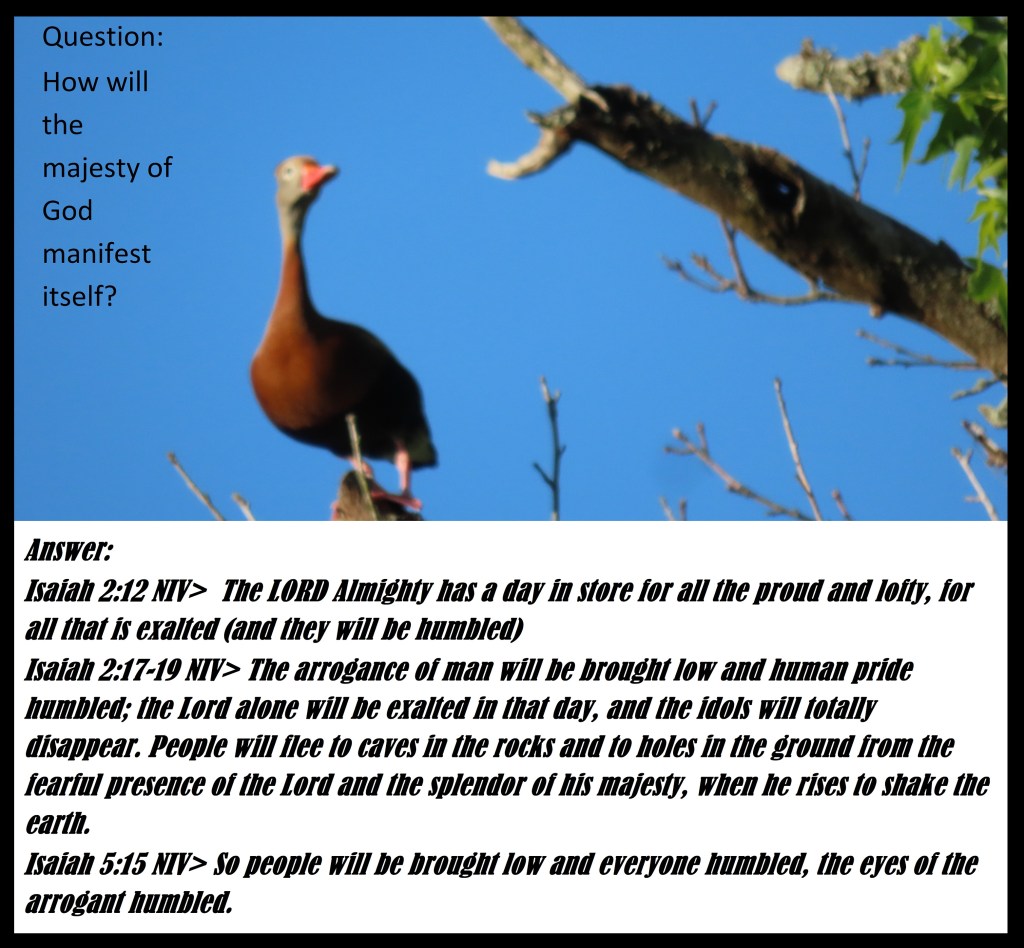
Question: How will the majesty of God manifest itself? Answer: Isaiah 2:12 NIV> The LORD Almighty has a day in store for all the proud and lofty, for all that is exalted (and they will be humbled) Isaiah 2:17-19 NIV> The arrogance of man will be brought low and human pride humbled; the Lord alone will be exalted in that day, and the idols will totally disappear. People will flee to caves in the rocks and to holes in the ground from the fearful presence of the Lord and the splendor of his majesty, when he rises to shake the earth. Isaiah 5:15 NIV> So people will be brought low and everyone humbled, the eyes of the arrogant humbled.
Isaiah was a prophet who spoke for God to the people of Judah, who were facing exile because of their idolatry and disobedience. Isaiah denounced idolatry as foolishness and insanity, and contrasted the powerlessness of idols with the sovereignty and glory of the holy one of Israel. Isaiah also proclaimed God’s promise of a new exodus and a new creation for his faithful remnant, who would be redeemed by the suffering servant. It reads in Isaiah 2:8 ESV> Their land is filled with idols; they bow down to the work of their hands, to what their own fingers have made. It reads in Isaiah 2:20 ESV>In that day mankind will cast away their idols of silver and their idols of gold; which they made for themselves to worship, to the moles and to the bats, It reads in Isaiah 17:8 ESV> He will not look to the altars, the work of his hands, and he will not look on what his own fingers have made, either the Asherim ” Asherim is a sacred wooden post, pole, or pillar that stood near the altar in various Canaanite high places and that symbolized the goddess Asherah. Asherim is also an ancient Semitic goddess, sometimes identified with Ashtoreth and Astarte, worshiped by the Phoenicians and Canaanites. It is also any of various upright wooden objects serving as a sacred symbol of Asherah.” or the altars of incense. It reads in Isaiah 31:7 ESV> For in that day everyone shall cast away his idols of silver and his idols of gold, which your hands have sinfully made for you. Isaiah 44:9-20 is a vivid example of Isaiah’s polemic against idolatry. He mocks the idol-makers who use the same wood to make a fire, bake bread, and carve a god. He exposes the absurdity of worshipping something that one has made with one’s own hands, and that cannot see, hear, or save. He also reveals the spiritual blindness and deception that idolatry causes in the human heart.
Question: How does Isaiah deal with the nature worship of his time? Answer: “You will be ashamed because of the sacred oaks in which you have delighted; you will be disgraced because of the gardens that you have chosen. Isaiah 1:29 NIV> You have forgotten God your Savior; you have not remembered the Rock, your fortress. Therefore, though you set out the finest plants and plant imported vines, Isaiah 17:10 NIV>




 "Only Life Changes"