Father God, my mind is open to Your Thoughts, and closed today to every thought but Yours. I rule my mind, and offer it to You. Accept my precious gift, for it is Yours to me. Amen and Amen.
07/13/2017 OCM-83656272 {Member of ULC 9/23/22
7545620-0414Susan Ruth Robertson202004377}
Question: What other figures of speech does the author use about God? Answer: It reads in Isaiah 42:13 NIV>The Lord will march out like a champion, like a warrior he will stir up his zeal; with a shout, he will raise the battle cry and will triumph over his enemies. It reads in Isaiah 59:17 NIV> He put on righteousness as his breastplate, and the helmet of salvation on his head; he put on the garments of vengeance and wrapped himself in zeal as in a cloak. It reads in Isaiah 63:3 NIV>“I have trodden the winepress alone; from the nations, no one was with me. I trampled them in my anger and trod them down in my wrath; their blood spattered my garments, and I stained all my clothing.
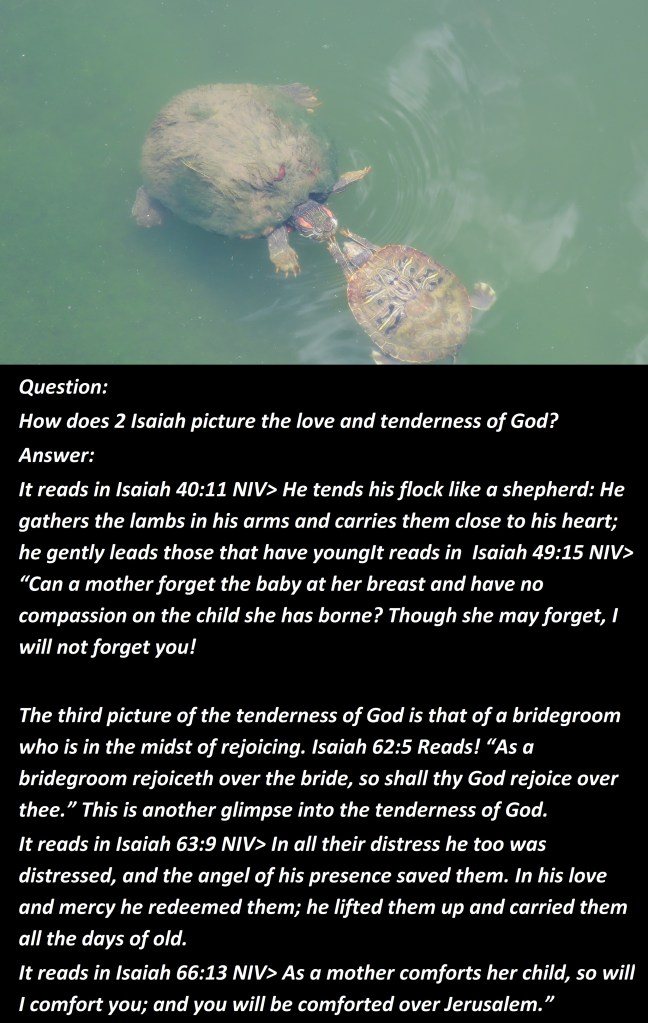
Question: How does 2 Isaiah picture the love and tenderness of God? Answer: It reads in Isaiah 40:11 NIV> He tends his flock like a shepherd: He gathers the lambs in his arms and carries them close to his heart; he gently leads those that have young. It reads in Isaiah 49:15 NIV> “Can a mother forget the baby at her breast and have no compassion on the child she has borne? Though she may forget, I will not forget you!
The third picture of the tenderness of God is that of a bridegroom who is in the midst of rejoicing. Isaiah 62:5 Reads! “As a bridegroom rejoiceth over the bride, so shall thy God rejoice over thee.” This is another glimpse into the tenderness of God. It reads in Isaiah 63:9 NIV> In all their distress he too was distressed, and the angel of his presence saved them. In his love and mercy, he redeemed them; he lifted them up and carried them all the days of old. It reads in Isaiah 66:13 NIV> As a mother comforts her child, so will I comfort you; and you will be comforted over Jerusalem.”
Question: How does 2 Isaiah deal with idols? Answer: Isaiah 44:14-17 NIV> He cut down cedars, or perhaps took a cypress or oak. He let it grow among the trees of the forest or planted a pine, and the rain made it grow. It is used as fuel for burning; some of it he takes and warms himself, he kindles a fire and bakes bread. But he also fashions a god and worships it; he makes an idol and bows down to it. Half of the wood he burns in the fire; over it, he prepares his meal, roasts his meat, and eats his fill. He also warms himself and says, “Ah! I am warm; I see the fire.” From the rest he makes a god, his idol; he bows down to it and worships. He prays to it and says, “Save me! You are my god!” Isaiah 40:18-20 NIV With whom, then, will you compare God? To what image will you liken him? As for an idol, a metalworker casts it, and a goldsmith overlays it with gold and fashions silver chains for it. A person too poor to present such an offering selects wood that will not rot; they look for a skilled worker to set up an idol that will not topple. Isaiah 46:6 NIV Some pour out gold from their bags and weigh out silver on the scales; they hire a goldsmith to make it into a god, and they bow down and worship it.
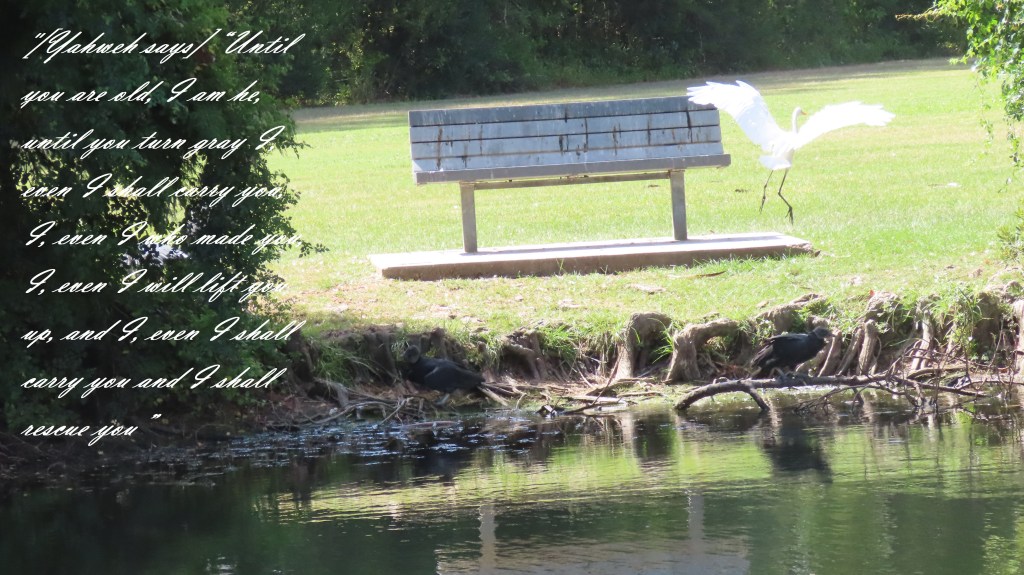
Read Philippians 1:6 NIV Remember the one who really loves you. “[Yahweh says] “Until you are old, I am he, until you turn gray I, even I shall carry you, I, even I who made you, I, even I will lift you up, and I, even I shall carry you and I shall rescue you”
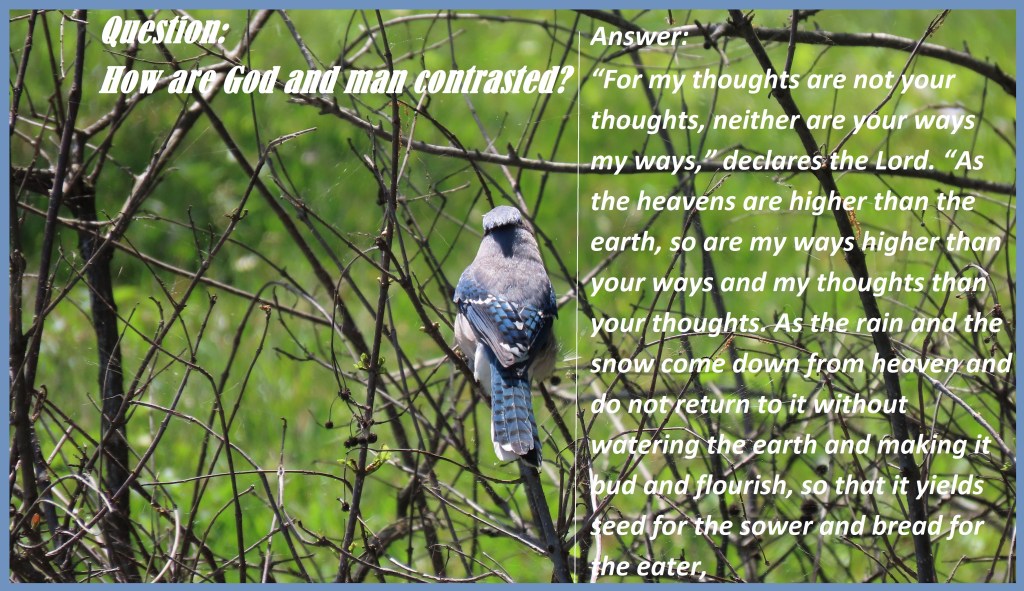
Question: How are God and man contrasted? Answer: “For my thoughts are not your thoughts, neither are your ways my ways,” declares the Lord. “As the heavens are higher than the earth, so are my ways higher than your ways and my thoughts than your thoughts. As the rain and the snow come down from heaven and do not return to it without watering the earth and making it bud and flourish, so that it yields seed for the sower and bread for the eater, Isaiah 55:8-10 NIV>
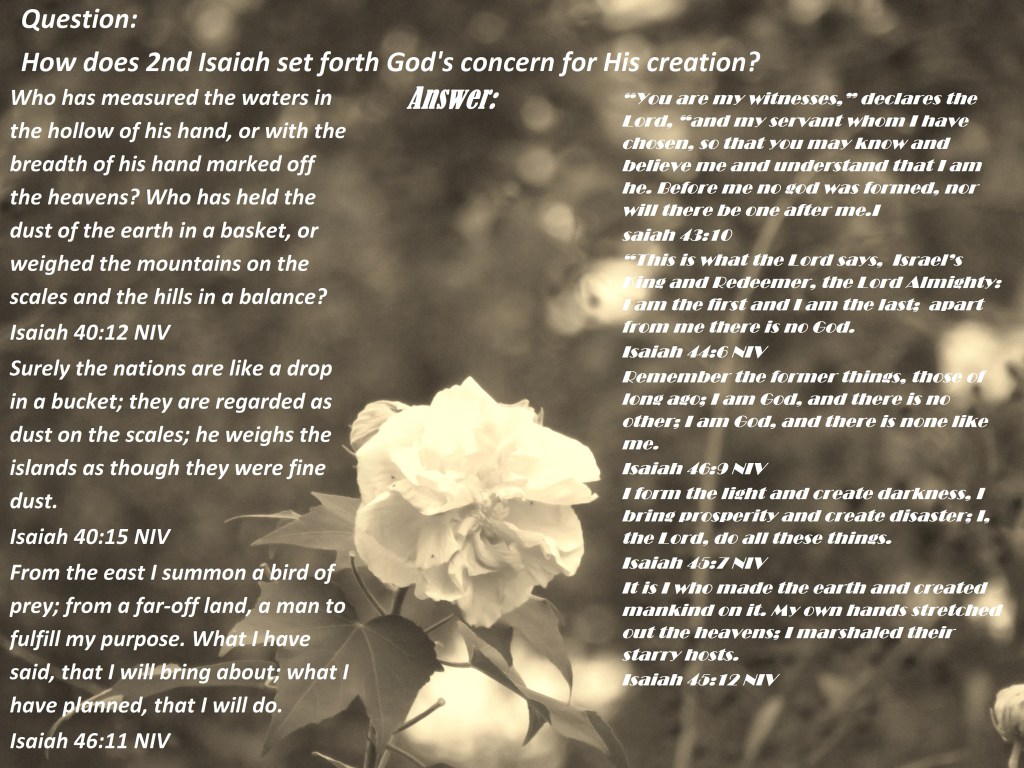
Question: How does 2nd Isaiah set forth God’s concern for His creation? Answer: Who has measured the waters in the hollow of his hand, or with the breadth of his hand marked off the heavens? Who has held the dust of the earth in a basket, or weighed the mountains on the scales and the hills in a balance?
Isaiah 40:12 NIV Surely the nations are like a drop in a bucket; they are regarded as dust on the scales; he weighs the islands as though they were fine dust.
Isaiah 40:15 NIV From the east I summon a bird of prey; from a far-off land, a man to fulfill my purpose. What I have said, that I will bring about; what I have planned, that I will do.
Isaiah 46:11 NIV “You are my witnesses,” declares the Lord, “and my servant whom I have chosen, so that you may know and believe me and understand that I am he. Before me no god was formed, nor will there be one after me.
Isaiah 43:10 “This is what the Lord says, Israel’s King and Redeemer, the Lord Almighty: I am the first and I am the last; apart from me there is no God.
Isaiah 44:6 NIV Remember the former things, those of long ago; I am God, and there is no other; I am God, and there is none like me.
Isaiah 46:9 NIV I form the light and create darkness, I bring prosperity and create disaster; I, the Lord, do all these things.
Isaiah 45:7 NIV It is I who made the earth and created mankind on it. My own hands stretched out the heavens; I marshaled their starry hosts.
Question: For what Nations other than Israel does Isaiah have a word? Answer: “Babylon” It reads in Isaiah 13:1-22 NIV>A prophecy against Babylon that Isaiah’s son of Amoz saw: Raise a banner on a bare hilltop, shout to them; beckon to them to enter the gates of the nobles. I have commanded those I prepared for battle; I have summoned my warriors to carry out my wrath, those who rejoice in my triumph. Listen, a noise on the mountains, like that of a great multitude! Listen, an uproar among the kingdoms, like nations massing together! The Lord Almighty is mustering an army for war. They come from faraway lands, from the ends of the heavens, the Lord and the weapons of his wrath, to destroy the whole country. Wail, for the day of the Lord is near; it will come like destruction from the Almighty. Because of this, all hands will go limp, every heart will melt with fear. Terror will seize them; pain and anguish will grip them; they will writhe like a woman in labor. They will look aghast at each other, their faces aflame. See, the day of the Lord is coming, a cruel day, with wrath and fierce anger, to make the land desolate and destroy the sinners within it. The stars of heaven and their constellations will not show their light. The rising sun will be darkened, and the moon will not give its light. I will punish the world for its evil, the wicked for their sins. I will put an end to the arrogance of the haughty and will humble the pride of the ruthless. I will make people scarcer than pure gold, rarer than the gold of Ophir. Therefore, I will make the heavens tremble; and the earth will shake from its place at the wrath of the Lord Almighty, in the day of his burning anger. Like a hunted gazelle, like sheep without a shepherd, they will all return to their own people, they will flee to their native land. Whoever is captured will be thrust through; all who are caught will fall by the sword. Their infants will be dashed to pieces before their eyes; their houses will be looted, and their wives violated. See, I will stir up against them the Medes, who do not care for silver and have no delight in gold. Their bows will strike down the young men; they will have no mercy on infants, nor will they look with compassion on children. Babylon, the jewel of kingdoms, the pride and glory of the Babylonians, will be overthrown by God like Sodom and Gomorrah. She will never be inhabited or lived in through all generations; there no nomads will pitch their tents, there no shepherds will rest their flocks. But desert creatures will lie there, jackals will fill her houses; there the owls will dwell, and there the wild goats will leap about. Hyenas will inhabit her strongholds, jackals her luxurious palaces. Her time is at hand, and her days will not be prolonged. “Philistia” It reads in Isaiah 14:29-32 NIV> Do not rejoice, all you Philistines, that the rod that struck you is broken; from the root of that snake will spring up a viper, its fruit will be a darting, venomous serpent. The poorest of the poor will find pasture, and the needy will lie down in safety. But your root I will destroy by famine; it will slay your survivors. Wail, you gate! Howl, you city! Melt away, all you Philistines! A cloud of smoke comes from the north, and there is not a straggler in its ranks. What answer shall be given to the envoys of that nation? “The Lord has established Zion, and in her his afflicted people will find refuge.” “Moab” It reads in Isaiah 15:1 NIV> A prophecy against Moab: Ar in Moab is ruined, destroyed in a night! Kir in Moab is ruined, destroyed in a night! It reads in Isaiah 16:14 NIV> But now the Lord says: “Within three years, as a servant bound by contract would count them, Moab’s splendor and all her many people will be despised, and her survivors will be very few and feeble.” “Damascus” It reads in Isaiah 17:1-14 NIV>A prophecy against Damascus: “See, Damascus will no longer be a city but will become a heap of ruins. The cities of Aroer will be deserted and left to flocks, which will lie down, with no one to make them afraid. The fortified city will disappear from Ephraim, and royal power from Damascus; the remnant of Aram will be like the glory of the Israelites, declares the Lord Almighty. “In that day the glory of Jacob will fade; the fat of his body will waste away. It will be as when reapers harvest the standing grain, gathering the grain in their arms, as when someone gleans heads of grain in the Valley of Rephaim. Yet some gleanings will remain, as when an olive tree is beaten, leaving two or three olives on the topmost branches, four or five on the fruitful boughs,” declares the Lord, the God of Israel. In that day people will look to their Maker and turn their eyes to the Holy One of Israel. They will not look to the altars, the work of their hands, and they will have no regard for the Asherah poles and the incense altars their fingers have made. In that day their strong cities, which they left because of the Israelites, will be like places abandoned to thickets and undergrowth. And all will be desolation. You have forgotten God your Savior; you have not remembered the Rock, your fortress.Therefore, though you set out the finest plants and plant imported vines, though on the day you set them out, you make them grow, and on the morning when you plant them, you bring them to bud, yet the harvest will be as nothing in the day of disease and incurable pain. Woe to the many nations that rage, they rage like the raging sea! Woe to the peoples who roar, they roar like the roaring of great waters! Although the peoples roar like the roar of surging waters, when he rebukes them they flee far away, driven before the wind like chaff on the hills, like tumbleweed before a gale. In the evening, sudden terror! Before the morning, they are gone! This is the portion of those who loot us, the lot of those who plunder us. “Egypt” It reads in Isaiah 19:1-24 NIV> A prophecy against Egypt: See, the Lord rides on a swift cloud and is coming to Egypt. The idols of Egypt tremble before him, and the hearts of the Egyptians melt with fear. “I will stir up Egyptian against Egyptian, brother will fight against brother, neighbor against neighbor, city against city, kingdom against kingdom.The Egyptians will lose heart, and I will bring their plans to nothing; they will consult the idols and the spirits of the dead, the mediums and the spiritists. I will hand the Egyptians over to the power of a cruel master, and a fierce king will rule over them,” declares the Lord, the Lord Almighty.The waters of the river will dry up, and the riverbed will be parched and dry. The canals will stink; the streams of Egypt will dwindle and dry up. The reeds and rushes will wither, also the plants along the Nile, at the mouth of the river. Every sown field along the Nile will become parched, will blow away and be no more. The fishermen will groan and lament, all who cast hooks into the Nile; those who throw nets on the water will pine away. Those who work with combed flax will despair, the weavers of fine linen will lose hope. The workers in cloth will be dejected, and all the wage earners will be sick at heart. The officials of Zoan are nothing but fools; the wise counselors of Pharaoh give senseless advice. How can you say to Pharaoh, “I am one of the wise men, a disciple of the ancient kings”? Where are your wise men now? Let them show you and make known what the Lord Almighty has planned against Egypt. The officials of Zoan have become fools, the leaders of Memphis are deceived; the cornerstones of her peoples have led Egypt astray. The Lord has poured into them a spirit of dizziness; they make Egypt stagger in all that she does, as a drunkard staggers around in his vomit. There is nothing Egypt can do, head or tail, palm branch or reed. In that day the Egyptians will become weaklings. They will shudder with fear at the uplifted hand that the Lord Almighty raises against them. And the land of Judah will bring terror to the Egyptians; everyone to whom Judah is mentioned will be terrified, because of what the Lord Almighty is planning against them. In that day five cities in Egypt will speak the language of Canaan and swear allegiance to the Lord Almighty. One of them will be called the City of the Sun. In that day there will be an altar to the Lord in the heart of Egypt, and a monument to the Lord at its border. It will be a sign and witness to the Lord Almighty in the land of Egypt. When they cry out to the Lord because of their oppressors, he will send them a savior and defender, and he will rescue them. So the Lord will make himself known to the Egyptians, and in that day they will acknowledge the Lord. They will worship with sacrifices and grain offerings; they will make vows to the Lord and keep them. The Lord will strike Egypt with a plague; he will strike them and heal them. They will turn to the Lord, and he will respond to their pleas and heal them. In that day there will be a highway from Egypt to Assyria. The Assyrians will go to Egypt and the Egyptians to Assyria. The Egyptians and Assyrians will worship together. In that day Israel will be the third, along with Egypt and Assyria, a blessing on the earth.
Question: What hope of immortality does the book hold out? Answer: It reads in Isaiah 25:8 NIV> He will swallow up death forever. The Sovereign Lord will wipe away the tears from all faces; he will remove his people’s disgrace from all the earth. The Lord has spoken. It reads in Isaiah 26:19 NIV> But your dead will live, Lord; their bodies will rise, let those who dwell in the dust wake up and shout for joy, your dew is like the dew of the morning; the earth will give birth to her dead.
Question: What is Isaiahs’s idea of the power of faith?
Answer: It reads in Isaih 7:9 NIV> The head of Ephraim is Samaria, and the head of Samaria is only Remaliah’s son. If you do not stand firm in your faith, you will not stand at all.’” It reads in Isaiah 8:17 NIV> I will wait for the Lord, who is hiding his face from the descendants of Jacob. I will put my trust in him. It reads in Isaiah 28:16 NIV> So this is what the Sovereign Lord says: “See, I lay a stone in Zion, a tested stone, a precious cornerstone for a sure foundation; the one who relies on it will never be stricken with panic.
Question: What is Isaiahs’s dream of the future for mankind? Answer: It reads in Isaiah 2:4 NIV> He will judge between the nations and will settle disputes for many peoples. They will beat their swords into plowshares and their spears into pruning hooks. Nation will not take up sword against nation, nor will they train for war anymore.
Question: What future is envisioned for Mount Zion? Answer: It reads in Isaiah 2:1-3 NIV> This is what Isaiah’s son of Amoz saw concerning Judah and Jerusalem: In the last days the mountain (Mount Zion) of the Lord’s temple will be established as the highest of the mountains; it will be exalted above the hills, and all nations will stream to it. Many peoples will come and say, “Come, let us go up to the mountain of the Lord, to the temple of the God of Jacob. He will teach us his ways, so that we may walk in his paths.” The law will go out from Zion, the word of the Lord from Jerusalem.





 "Only Life Changes"