And when Jesus was entered into Capernaum, there came unto him a centurion, beseeching him, And saying, Lord, my servant lieth at home sick of the palsy, grievously tormented. And Jesus saith unto him, I will come and heal him. The centurion answered and said, Lord, I am not worthy that thou shouldest come under my roof: but speak the word only, and my servant shall be healed. For I am a man under authority, having soldiers under me: and I say to this man, Go, and he goeth; and to another, Come, and he cometh; and to my servant, Do this, and he doeth it. When Jesus heard it, he marvelled, and said to them that followed, Verily I say unto you, I have not found so great faith, no, not in Israel. And I say unto you, That many shall come from the east and west, and shall sit down with Abraham, and Isaac, and Jacob, in the kingdom of heaven. Matthew 8:5-11 The mind can heal the body, but the body can not heal the mind. We have a choice in this life. God gave us this powerful mind and two choices. Either we can do and walk right or we can do bad and walk in with the falling world that doesn’t grow but gathers conflict and troubles.
Believing in Christ will set you free to do what is right. Amen. {Treasure Box} In all thy ways acknowledge him, and he shall direct thy paths. Be not wise in thine own eyes: fear the LORD, and depart from evil. Proverbs 3:6-7 {Prayer} O God, help me to keep You first in my life in Jesus Precious Name Amen. {Praise ye the LORD. O give thanks unto the LORD; for he is good: for his mercy endures for ever. Who can utter the mighty acts of the LORD? who can shew forth all his praise? Blessed are they that keep judgment, and he that doeth righteousness at all times.
Chapter 81 This psalm was penned, as is supposed, not upon occasion of any particular providence, but for the solemnity of a particular ordinance, either that of the new-moon in general or that of the feast of trumpets on the new moon of the seventh month, {Lev. 23:24 ~ Speak unto the children of Israel, saying, In the seventh month, in the first day of the month, shall ye have a sabbath, a memorial of blowing of trumpets, an holy convocation.}; {Num. 29:1 ~And in the seventh month, on the first day of the month, ye shall have an holy convocation; ye shall do no servile work: it is a day of blowing the trumpets unto you.}When David, by the Spirit, introduced the singing of psalms into the temple-service this psalm was intended for that day, to excite and assist the proper devotions of it. Psalm 81 To the chief Musician upon Gittith, [A Psalm] of Asaph. Psalm 81: The background of the psalm appears to be the Feast of Tabernacles arrow up arrow right (Lev. 23:34-44 ~ Speak unto the children of Israel, saying, The fifteenth day of this seventh month shall be the feast of tabernacles for seven days unto the LORD. On the first day shall be an holy convocation: ye shall do no servile work therein. Seven days ye shall offer an offering made by fire unto the LORD: on the eighth day shall be an holy convocation unto you; and ye shall offer an offering made by fire unto the LORD: it is a solemn assembly; and ye shall do no servile work therein. These are the feasts of the LORD, which ye shall proclaim to be holy convocations, to offer an offering made by fire unto the LORD, a burnt offering, and a meat offering, a sacrifice, and drink offerings, every thing upon his day: Beside the sabbaths of the LORD, and beside your gifts, and beside all your vows, and beside all your freewill offerings, which ye give unto the LORD. Also in the fifteenth day of the seventh month, when ye have gathered in the fruit of the land, ye shall keep a feast unto the LORD seven days: on the first day shall be a sabbath, and on the eighth day shall be a sabbath. And ye shall take you on the first day the boughs of goodly trees, branches of palm trees, and the boughs of thick trees, and willows of the brook; and ye shall rejoice before the LORD your God seven days. And ye shall keep it a feast unto the LORD seven days in the year. It shall be a statute for ever in your generations: ye shall celebrate it in the seventh month. Ye shall dwell in booths seven days; all that are Israelites born shall dwell in booths: That your generations may know that I made the children of Israel to dwell in booths, when I brought them out of the land of Egypt: I am the LORD your God. And Moses declared unto the children of Israel the feasts of the LORD. ), which reminded the people of God’s law and also constituted the feast of ingathering (Exodus 23:16 ~ And the feast of harvest, the first~fruits of thy labors, which thou hast sown in the field: and the feast of ingathering, which is in the end of the year, when thou hast gathered in thy labors out of the field.). The psalm is composed of three distinct parts.
Psalm Chapter 81:1-16 ~Sing aloud unto God our strength: make a joyful noise unto the God of Jacob. Take a psalm, and bring hither the timbrel, the pleasant harp with the psaltery. Blow up the trumpet in the new moon, in the time appointed, on our solemn feast day. For this was a statute for Israel, and a law of the God of Jacob. This he ordained in Joseph for a testimony, when he went out through the land of Egypt: where I heard a language that I understood not. I removed his shoulder from the burden: his hands were delivered from the pots. Thou called in trouble, and I delivered thee; I answered thee in the secret place of thunder: I proved thee at the waters of Meribah. Selah. Hear, O my people, and I will testify unto thee: O Israel, if thou wilt hearken unto me; There shall no strange god be in thee; neither shalt thou worship any strange god. I am the LORD thy God, which brought thee out of the land of Egypt: open thy mouth wide, and I will fill it. But my people would not hearken to my voice; and Israel would none of me. So I gave them up unto their own hearts’ lust: and they walked in their own counsels. Oh that my people had hearkened unto me, and Israel had walked in my ways! I should soon have subdued their enemies, and turned my hand against their adversaries. The haters of the LORD should have submitted themselves unto him: but their time should have endured for ever. He should have fed them also with the finest of the wheat: and with honey out of the rock should I have satisfied thee. Father God, I am believing for those who are in need, that are depressed or are just afflicted by the chaos that You will let them no You are right with them in their situation. Rescue all those who are in slavery and bond by their sins. I am believing blessings and help for the orphans and widows. Guide encouragement in all lives today. I thank You, praise You and give You all the glory in Jesus Precious Name Amen. Oh that my people had hearkened unto me, and Israel had walked in my ways! Psalm 81:13
Good morning! {Treasure Box} I love them that love Me; and those that seek Me early shall find Me. Proverbs 8:17 {Prayer} “God, help us to read and obey Your Word, asking guidance of the Holy Spirit for our lives in Jesus Precious Name Amen.”
I {John} write to inform you of a message from Him who walks among the churches and holds their leaders in His right hand. He says to you: I know how many good things you are doing. I have watched your hand work and your patience; I know you don’t tolerate sin among your members, and you have carefully examined the claims of those who say they are apostles, but aren’t. You have found out how they lie. You have patiently suffered for Me without quitting. Yet there is one thing wrong; you don’t love Me as at first! Think about those times of your first love {How different now!} and turn back to Me again. Revelation 2:1-5 For His mercy towards those who fear and honor Him is as great as the height of the heavens above the earth. Psalm 103:11
Have a awesome day full of blessings and joy. Much love in Christ Our Lord and Savior!!
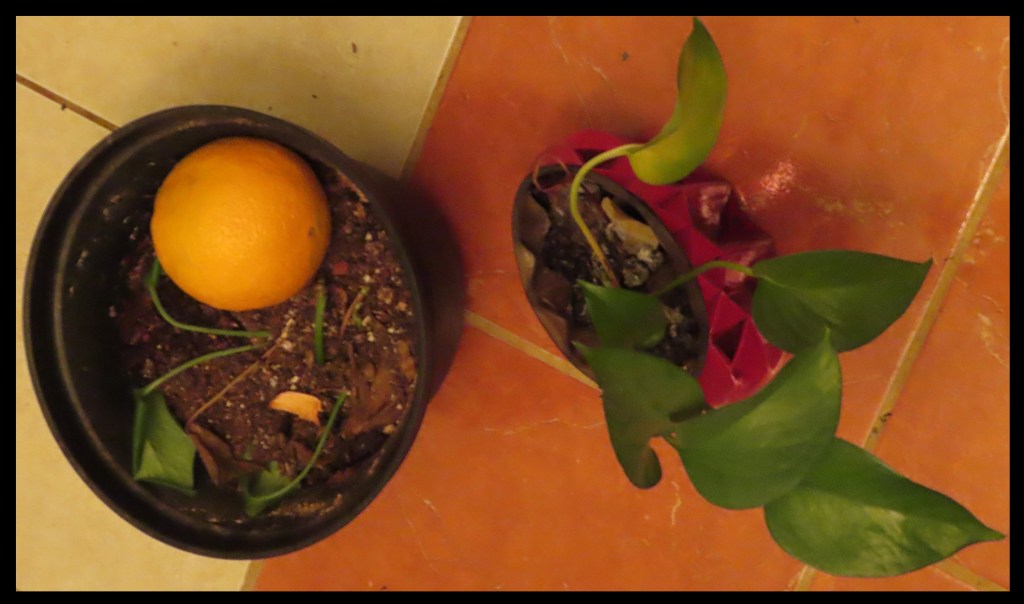
I get inspired by plants. I found this ivy outside that’s been walked on by the dogs. It was growing by the bush. So I brought it in and put in a pot of its own and it don’t have to suffer no more. So it is going to grow in the house. Isn’t this like sin. This plant had to suffer till I brought it in to take care of it. Isn’t this like God he takes us and makes us new. We all sinned and fallen short of the glory of God. ‘Romans 3:23’ I believe. I am sorry I didn’t write this down. So I am remembering what I said on the video. It is not exactly as I said it. But when I do the video it will type what I say. But unfortunately I don’t have a normal voice. So the video says what ever it hears. LOL! I remember last week we bought a big bag of oranges and there was this orange that had green stuff growing on it. It was in a bag of good oranges. But isn’t this like sin. Take that green orange and cut it open and their are seeds that you can grow trees with. So we can ditch the sin and grow right. God will give us the courage to move from bad to good. Because I can not write what I said in the video. I want you to think about all the inspiration you have seen in your life through the years. What parts of your life was sinful, but you overcame the sin. You now have learned more and are growing in your faith. This is what God wants. He gave you a powerful mind to overcome the stuff that binds you and keeps you in a closed closet that has the lock on the outside and you are stuck. God don’t want you to be stuck. God wants you to be free. He has opened the door to freedom in Christ just for you. Remember all the good times in your life. Not the bad. Just the good and right it down. Find that the good out weighs the bad. I can remember the good can show that the bad was just temporary and God has brought a lot of good out of this in my life. You will see God has brought you blessings though your life. Suffering may increase knowledge, but doing right gives us God’s wisdom. Amen! Never give up!
You know how much persecution and suffering I have endured. You know all about how I was persecuted in Antioch, Iconium, and Lystra—but the Lord rescued me from all of it. Yes, and everyone who wants to live a godly life in Christ Jesus will suffer persecution. 2 Timothy 3:11-12 But you must remain faithful to the things you have been taught. You know they are true, for you know you can trust those who taught you. You have been taught the holy Scriptures from childhood, and they have given you the wisdom to receive the salvation that comes by trusting in Christ Jesus. All Scripture is inspired by God and is useful to teach us what is true and to make us realize what is wrong in our lives. It corrects us when we are wrong and teaches us to do what is right. 1God uses it to prepare and equip his people to do every good work. 2 Timothy 3:14-17 I remember when I was growing up our parents, we go to church it is good we have good memories how we have to walk right in Jesus. {Treasure Box} “Till heaven and earth pass, one jot or one tittle shall in no wise pass from the law, till all be for filled. Matthew 5:18 {Prayer: I’m so grateful that You are never too busy to remember Your promises, Lord in Jesus Precious Name Amen. } It reads in Proverbs 2:6 For the Lord grants wisdom! His every word is a treasure of knowledge and understanding.
Psalm 80: This psalm is concerned in its entirety with Israel, the northern kingdom. It seems to refer to the fall of Samaria, the capital, in 722 B.C., and constitutes a prayer that the Lord would restore His people. Restoring Israel, the Sheep and Vineyard of the LORD This psalm is titled To the Chief Musician. Set to “The Lilies.” A Testimony of Asaph. The Messiah, the Protector and Saviour of the church, is the Man of God’s right hand; he is the Arm of the Lord, for all power is given to him. In him is our strength, by which we are enabled to persevere to the end. “Background”: The backdrop for the Psalms is twofold: (2) The history of Israel. Historically, the psalms range in time from the origin of life to the post-Exilic joys of the Jews liberated from Babylon. Thematically, the psalms cover a wide spectrum of topics, ranging from heavenly worship to earthly war. Psalm Chapter 80:1-19
Give ear, O Shepherd of Israel, thou that leadest Joseph like a flock; thou that dwellest between the cherubims, shine forth. Before Ephraim and Benjamin and Manasseh stir up thy strength, and come and save us. Turn us again, O God, and cause thy face to shine; and we shall be saved. O LORD God of hosts, how long wilt thou be angry against the prayer of thy people? Thou feedest them with the bread of tears; and givest them tears to drink in great measure. Thou makest us a strife unto our neighbours: and our enemies laugh among themselves. Turn us again, O God of hosts, and cause thy face to shine; and we shall be saved. Thou hast brought a vine out of Egypt: thou hast cast out the heathen, and planted it. Thou preparedst room before it, and didst cause it to take deep root, and it filled the land. The hills were covered with the shadow of it, and the boughs thereof were like the goodly cedars. She sent out her boughs unto the sea, and her branches unto the river. Why hast thou then broken down her hedges, so that all they which pass by the way do pluck her? The boar out of the wood doth waste it, and the wild beast of the field doth devour it. Return, we beseech thee, O God of hosts: look down from heaven, and behold, and visit this vine; And the vineyard which thy right hand hath planted, and the branch that thou madest strong for thyself. It is burned with fire, it is cut down: they perish at the rebuke of thy countenance. Let thy hand be upon the man of thy right hand, upon the son of man whom thou madest strong for thyself. So will not we go back from thee: quicken us, and we will call upon thy name. Turn us again, O LORD God of hosts, cause thy face to shine; and we shall be saved.
Let thy hand be upon the man of thy right hand, upon the son of man whom thou madest strong for thyself. Psalm 80:17
Father God, I thank You, Praise You and give You all the glory that no problem or circumstances that I face in this life time is to difficult for You. You are the God of the impossible. I thank You and praise You for Your word, the spiritual truths and life learning principles that I have been learning. I know that no one can learn about You over night and all Your promises You have for everyone who believes in the :Lord Jesus Christ. But as I walk, talk and am guided by You. This is a win! Win Situation! Let my out side prayers be as strong as my inside prayers. Help me to listen carefully to Your voice and not the enemies. I love You, thank You, praise You and give You all the glory in Your Precious Name Jesus Amen.
In Matthew 8:20 it reads: Jesus replied, “Foxes have dens and birds have nests, but the Son of Man has no place to lay his head.” In Matthew 9:13 it reads: Then he added, “Now go away and learn the meaning of this verse of Scripture, ‘It isn’t your sacrifices and your gifts I want—I want you to be merciful.’ For I have come to urge sinners, not the self-righteous, back to God.” In Matthew 11:6 it Reads: Blessed is anyone who does not stumble on account of me.” In Matthew 11:28-30 it reads: Jesus says: “Come to Me, all you who labour and are heavy laden, and I will give you rest. Take My yoke upon you and learn from Me, for I am gentle and lowly in heart, and you will find rest for your souls. For My yoke is easy and My burden is light.”
“You have given me Your salvation as my shield. Your right hand, O’ Lord, supports me.” Psalm 18:35
{Treasure Box} “The Lord is nigh unto all them that call upon Him, to all that call upon Him in truth.” Psalm 145:18 {Prayer} Lord, give me grace and strength to persevere and an obedient heart to do Your will in Jesus Precious Name Amen.
The Story of Psalm 79 Something bad had happened to the *Jews. They had not obeyed God, so he let their enemies beat them. Bible students think that this happened 600 years before Jesus came to the earth. A country called Babylon destroyed Jerusalem and took many people away as *prisoners. Maybe this psalm is by one of the *prisoners. A companion poem to (Psalm 74), this psalm laments the destruction of Jerusalem at the time of the Babylonian captivity. The psalm has two distinct parts: expression of the lament to God (verses 1-5), and petition to God for deliverance of His people and retribution on their enemies (verses 6-13). PSALM 79:1-13 O’ GOD, the heathen are come into thine inheritance; thy holy temple have they defiled; they have laid Jerusalem on heaps. The dead bodies of thy servants have they given to be meat unto the fowls of the heaven, the flesh of thy saints unto the beasts of the earth. Their blood have they shed like water round about Jerusalem; and there was none to bury them. We are become a reproach to our neighbors, a scorn and derision to them that are round about us. How long, LORD? wilt thou be angry for ever? shall thy jealousy burn like fire? Pour out thy wrath upon the heathen that have not known thee, and upon the kingdoms that have not called upon thy name. For they have devoured Jacob, and laid waste his dwelling place. O remember not against us former iniquities: let thy tender mercies speedily prevent us: for we are brought very low. Help us, O God of our salvation, for the glory of thy name: and deliver us, and purge away our sins, for thy name’s sake. Wherefore should the heathen say, Where is their God? let him be known among the heathen in our sight by the revenging of the blood of thy servants which is shed. Let the sighing of the prisoner come before thee; according to the greatness of thy power preserve thou those that are appointed to die; And render unto our neighbors sevenfold into their bosom their reproach, wherewith they have reproached thee, O Lord. So we thy people and sheep of thy pasture will give thee thanks for ever: we will shew forth thy praise to all generations.
Father God, help us, your people, to be salt and light in this forsaking world.. cause us to be united under your banner of love. Change us and change the world for your glory. Where there is discord, bring unity. I thank You, praise You and give You all the glory in Jesus Precious Name Amen. {Power Verse} Help us, O God of our salvation, for the glory of thy name: and deliver us, and purge away our sins, for thy name’s sake. Psalm 79:9
Never forget that God loves you! No matter what title this world throws at you. You are God’s and He will never leave you nor forsake you as this world does. Never give up doing good! God has more of His children that will encourage you and guide. 3 Definitions of a sinner all having the same meaning just worded different: Sinner- a person who transgresses against divine law by committing an immoral act or acts. But go and learn what this means: ‘I desire mercy, not sacrifice.’ For I have not come to call the righteous, but sinners.
“Matthew 9:13
Criminal-a person who has committed a crime. For all have sinned and fall short of the glory of God,
Romans 3:23
Felon-a crime, typically one involving violence, regarded as more serious than a misdemeanor, and usually punishable by imprisonment for more than one year or by death. Whether you’ve been let down by disappointment, rejection, or resentment Jesus came to heal your heart. (Jesus said about the Father, “He has sent Me to heal the brokenhearted” (Luke 4:18 ) This world talks about bullying and framing others for crimes, but the perfect people of this world (They Think) do this in secret: To sinners, criminals and felons and get away with it. People go to court for a crime and they say if you admit to the crime since you can’t afford a attorney, you get less time served in jail. Hmm what a world we live in. Corrupt: having or showing a willingness to act dishonestly in return for money or personal gain.
For all have sinned and fall short of the glory of God, Romans 3:23
“The Hatred of the World” (English Standard Version) “If the world hates you, know that it has hated me before it hated you. If you were of the world, the world would love you as its own; but because you are not of the world, but I chose you out of the world, therefore the world hates you. Remember the word that I said to you: ‘A servant is not greater than his master.’ If they persecuted me, they will also persecute you. If they kept my word, they will also keep yours. But all these things they will do to you on account of my name, because they do not know him who sent me. If I had not come and spoken to them, they would not have been guilty of sin, but now they have no excuse for their sin. Whoever hates me hates my Father also. If I had not done among them the works that no one else did, they would not be guilty of sin, but now they have seen and hated both me and my Father. But the word that is written in their Law must be fulfilled: ‘They hated me without a cause.’
John 15:18-25
Definition of practice makes perfect —used to say that people become better at something if they do it often If you want to be a good writer, you should write every day. Remember, practice makes perfect. What kind of perfection does Jesus Christ have? He was morally perfect. That is one kind of perfection or completion. But there is another kind of perfection or completion that comes only by experience. Jesus entered fully into the sufferings of this world and emerged victorious over them. He was completed in his experience on the earth by the things he suffered.
What does the Bible say about making you perfect? The action of repenting; sincere regret or remorse. (Repentance) Father God, it is written in Your Word that if I confess with my mouth that Jesus is Lord and believe in my heart that You have raised Him from the dead, I shall be saved. Therefore, Father, I confess that Jesus is my Lord. I make Him Lord of my life right now In Jesus Precious Name Amen. Make you perfect in every good work to do His will, walking in righteousness, doing in you that which is well-pleasing before Him, through Jesus Christ, to whom [is] the glory — to the ages of the ages! Amen. Hebrews 13:21 Make you perfect in every good work to do his will. By supplying what is defective. Working in you. See Philippians 2:13 For it is God who works in you to will and to act in order to fulfill his good purpose. God, he made known to us the mystery of his will according to his good pleasure, which he purposed in Christ, to be put into effect when the times reach their fulfillment-to bring unity to all things in heaven and on earth under Christ. In him we were also chosen, having been predestined according to the plan of him who works out everything in conformity with the purpose of his will, in order that we, who were the first to put our hope in Christ, might be for the praise of his glory. And you also were included in Christ when you heard the message of truth, the gospel of your salvation. When you believed, you were marked in him with a seal, the promised Holy Spirit, Ephesians 1:9-13 {Treasure Box} “He knows the way that I take: when He has tried me, I shall come forth as gold.
Job 23:10 {Prayer} Dear Lord, I desire today that You will use my life as a channel of Your love in Jesus Precious Name Amen.
In Psalm 119:43: May I never forget Your word; for they are my only hope. I hope you have a great wonderful day full of blessings and joy. Enjoy this new day God has given you Amen!
Summary for Psalm 78: Give ear, O my people, to my law: Psalm 78 is a wisdom psalm, written to instruct God’s people. The theme is the goodness and kindness of God to His stubborn and rebellious people. Asaph began by asking for the attention of God’s people so they could hear the wisdom he would speak. Did not continue to follow Psalm 78? We do not know who wrote the psalm. Maybe it was Isaiah after the fall of Ephraim, 720 years before Jesus was born. Ephraim was the name of the largest group of families in Israel. The whole psalm is a story, the story (*history) of God’s people until the time of King David. Psalm Chapter 78:1-72 Give ear, O my people, to my law: incline your ears to the words of my mouth. I will open my mouth in a parable: I will utter dark sayings of old: Which we have heard and known, and our fathers have told us. We will not hide them from their children, shewing to the generation to come the praises of the LORD, and his strength, and his wonderful works that he hath done. For he established a testimony in Jacob, and appointed a law in Israel, which he commanded our fathers, that they should make them known to their children: That the generation to come might know them, even the children which should be born; who should arise and declare them to their children: That they might set their hope in God, and not forget the works of God, but keep his commandments: And might not be as their fathers, a stubborn and rebellious generation; a generation that set not their heart aright, and whose spirit was not steadfast with God. The children of Ephraim, being armed, and carrying bows, turned back in the day of battle. They kept not the covenant of God, and refused to walk in his law; And forgot his works, and his wonders that he had shewed them. Marvelous things did he in the sight of their fathers, in the land of Egypt, in the field of Zoan. He divided the sea, and caused them to pass through; and he made the waters to stand as an heap. In the daytime also he led them with a cloud, and all the night with a light of fire. He clave the rocks in the wilderness, and gave them drink as out of the great depths. He brought streams also out of the rock, and caused waters to run down like rivers. And they sinned yet more against him by provoking the most High in the wilderness. And they tempted God in their heart by asking meat for their lust. Yea, they spoke against God; they said, Can God furnish a table in the wilderness? Behold, he smote the rock, that the waters gushed out, and the streams overflowed; can he give bread also? can he provide flesh for his people? Therefore the LORD heard this, and was wroth: so a fire was kindled against Jacob, and anger also came up against Israel; Because they believed not in God, and trusted not in his salvation: Though he had commanded the clouds from above, and opened the doors of heaven, And had rained down manna upon them to eat, and had given them of the corn of heaven. Man did eat angels’ food: he sent them meat to the full. He caused an east wind to blow in the heaven: and by his power he brought in the south wind. He rained flesh also upon them as dust, and feathered fowls like as the sand of the sea: And he let it fall in the midst of their camp, round about their habitations. So they did eat, and were well filled: for he gave them their own desire; They were not estranged from their lust. But while their meat was yet in their mouths, The wrath of God came upon them, and slew the fattest of them, and smote down the chosen men of Israel. For all this they sinned still, and believed not for his wondrous works. Therefore their days did he consume in vanity, and their years in trouble. When he slew them, then they sought him: and they returned and enquired early after God. And they remembered that God was their rock, and the high God their redeemer. Nevertheless they did flatter him with their mouth, and they lied unto him with their tongues. For their heart was not right with him, neither were they steadfast in his covenant. But he, being full of compassion, forgave their iniquity, and destroyed them not: yea, many a time turned he his anger away, and did not stir up all his wrath. For he remembered that they were but flesh; a wind that passes away, and cometh not again. How oft did they provoke him in the wilderness, and grieve him in the desert! Yea, they turned back and tempted God, and limited the Holy One of Israel. They remembered not his hand, nor the day when he delivered them from the enemy. How he had wrought his signs in Egypt, and his wonders in the field of Zoan: And had turned their rivers into blood; and their floods, that they could not drink. He sent divers sorts of flies among them, which devoured them; and frogs, which destroyed them. He gave also their increase unto the caterpillar, and their labor unto the locust. He destroyed their vines with hail, and their sycamore trees with frost. He gave up their cattle also to the hail, and their flocks to hot thunderbolts. He cast upon them the fierceness of his anger, wrath, and indignation, and trouble, by sending evil angels among them. He made a way to his anger; he spared not their soul from death, but gave their life over to the pestilence; And smote all the firstborn in Egypt; the chief of their strength in the tabernacles of Ham: But made his own people to go forth like sheep, and guided them in the wilderness like a flock. And he led them on safely, so that they feared not: but the sea overwhelmed their enemies. And he brought them to the border of his sanctuary, even to this mountain, which his right hand had purchased. He cast out the heathen also before them, and divided them an inheritance by line, and made the tribes of Israel to dwell in their tents. Yet they tempted and provoked the most high God, and kept not his testimonies: But turned back, and dealt unfaithfully like their fathers: they were turned aside like a deceitful bow. For they provoked him to anger with their high places, and moved him to jealousy with their graven images. When God heard this, he was wroth, and greatly abhorred Israel: So that he forsook the tabernacle of Shiloh, the tent which he placed among men; And delivered his strength into captivity, and his glory into the enemy’s hand. He gave his people over also unto the sword; and was wroth with his inheritance. The fire consumed their young men; and their maidens were not given to marriage. Their priests fell by the sword; and their widows made no lamentation. Then the LORD awaked as one out of sleep, and like a mighty man that shouted by reason of wine. And he smote his enemies in the hinder parts: he put them to a perpetual reproach. Moreover he refused the tabernacle of Joseph, and chose not the tribe of Ephraim: But chose the tribe of Judah, the mount Zion which he loved. And he built his sanctuary like high palaces, like the earth which he hath established for ever. He chose David also his servant, and took him from the sheepfolds: From following the ewes great with young he brought him to feed Jacob his people, and Israel his inheritance. So he fed them according to the integrity of his heart; and guided them by the skillfulness of his hands.
Father God, Jehovah Rapha I am believing healing, and for the war to stop in Israel and Gaza. I thank You for the many lessons that we may learn from Israel’s past history and Your long-suffering grace towards them. I pray that I may learn all that You would teach me from their past failures, so that I may not repeat the mistakes or the pain and suffering from the past. I am believing, Father God, that I may walk in integrity of heart and humility of spirit all the days of my life, for Your power and greater praise and glory. I thank You, praise You, love You and give You all the glory in Jesus Precious Name Amen.
{Power Verse} And he smote his enemies in the hinder parts: he put them to a perpetual reproach. Psalm 78:66
Good morning. Not to be self centered! But! When I was growing up. I would go to church, which by the way was like going to heaven. When I went home it was like going to hell, but my mom was in our corner being Jesus to us. Then when I would go to school it was like being in purgatory. Where there was other students who pick on ya! Where boys would spit on ya in school! Get picked on! But the best part was the counselors and teachers that was being Jesus to us. The walks home was great most of the time. Walking in the rain, snow or even a sunny day. It was beautiful. People most of the time tend to be respectable and nice. This was freedom in Christ. Being able to walk to the store for the elderly or do their laundry. Even sitting with them talking about their old times, when I didn’t have to rush home to do homework or chores. I loved being out side and feeling free, away from the struggles that bonded me. Those memories are the strongest in my memory that keep me going and going to church on Sundays and Wednesday to choir practice and singing in the choir. Staying focused on all the good in my life. Focusing on the good in one’s life will simply keep us focused on Christ. {Treasure Box} As I was with Moses’ so I will be with thee. Joshua 3:7
Prayer: Dear Lord, please remove all doubt from my mind and help me to have faith in Your promises in Jesus Precious Name Amen.
In Mathew 6:26-28 it reads: Look at the birds of the air; they do not sow or reap or store away in barns, and yet your heavenly Father feeds them. Are you not much more valuable than they? Can any one of you by worrying add a single hour to your life? “And why do you worry about clothes? See how the flowers of the field grow. They do not labor or spin.
Consider all the wild flowers and bluebonnets that are on the side of the road as we drive or walk by them. Even the Lilly’s I grow their design is not the same. They have different names and are beautiful. They are not all the same, but when the wind blows they sway in different directions. They are free. They have no worries. They don’t work hard or whirl around quickly. They are simply beautiful. The sea and its waves have a swaying talent of their own. Why we should not be anxiously concerned about the future, is the example of the smaller animals, which the providence of God feeds without their own labor; though he be not their father. We never knew an earthly father take care of his fowls, and neglect his children; and shall we fear this from our heavenly Father? God forbid! That man is utterly unworthy to have God for his father, who depends less upon his goodness, wisdom, and power, than upon a crop of corn, which may be spoiled either in the field or in the barn. If our great Creator have made us capable of knowing, loving, and enjoying himself eternally, what may we not expect from him, after so great a gift? I hope this message touched someone’s heart. You know that Jesus is right with you and he loves you and He will never leave you. Don’t give up your walk with Jesus cause He will never give up on you. Have a wonderful day full of blessings and enjoy Gods gift to you this day.