Father God, let this reading open up minds and touch someone’s heart in Jesus Precious Name Amen. In those days the multitude being very great, and having nothing to eat, Jesus called his disciples unto him, and saith unto them, I have compassion for these people. In the 8th chapter is the center of Mark’s gospel and here a couple important events occur Peter confesses Jesus’ true nature as the Messiah and Jesus predicts that he will have to suffer and die but will rise again. From this point on everything leads directly to Jesus’ eventual passion and resurrection. Jesus Feeds the Four Thousand in Mark 8:1-13 it reads: During those days another large crowd gathered. Since they had nothing to eat, Jesus called his disciples to him and said, “I have compassion for these people; they have already been with me three days and have nothing to eat. If I send them home hungry, they will collapse on the way, because some of them have come a long distance.” His disciples answered, “But where in this remote place can anyone get enough bread to feed them?” “How many loaves do you have?” Jesus asked. “Seven,” they replied. He told the crowd to sit down on the ground. When he had taken the seven loaves and given thanks, he broke them and gave them to his disciples to distribute to the people, and they did so. They had a few small fish as well; he gave thanks for them also and told the disciples to distribute them. The people ate and were satisfied. Afterward the disciples picked up seven basketfuls of broken pieces that were left over. About four thousand were present. After he had sent them away, he got into the boat with his disciples and went to the region of Dalmanutha. The Pharisees came and began to question Jesus. To test him, they asked him for a sign from heaven. He sighed deeply and said, “Why does this generation ask for a sign? Truly I tell you, no sign will be given to it.” Then he left them, got back into the boat and crossed to the other side. This the fourth of a series of stories about bread and righteousness, in which the disciples again miss Jesus’ point. ”Bread” represents God’s provision, whether that be literal. But Jesus uses an unqualified object. It’s like saying, “I’m hungry for all the bread” or “all the water.” True believers are hungry for complete righteousness, not partial righteousness. It’s not OK to love God, and yet compromise in their language, practice dishonesty, or commit any sin’s.
The Yeast of the Pharisees and Herod it reads in Mark 8:14-21 The disciples had forgotten to bring bread, except for one loaf they had with them in the boat. “Be careful,” Jesus warned them. “Watch out for the yeast of the Pharisees and that of Herod.” They discussed this with one another and said, “It is because we have no bread.” Aware of their discussion, Jesus asked them: “Why are you talking about having no bread? Do you still not see or understand? Are your hearts hardened? Do you have eyes but fail to see, and ears but fail to hear? And don’t you remember? When I broke the five loaves for the five thousand, how many basketfuls of pieces did you pick up?” “Twelve,” they replied. “And when I broke the seven loaves for the four thousand, how many basketfuls of pieces did you pick up?” They answered, “Seven.” He said to them, “Do you still not understand?” This is not the first time Jesus has healed the blind. He had done other such miracles before John the Baptist died (Luke 7:22, Jesus answered and said to them, “Go and tell John the things you have seen and heard: that the blind see, the lame walk, the lepers are cleansed, the deaf hear, the dead are raised, the poor have the gospel preached to them.), but it is the first recorded in Mark’s Gospel. It’s possible the people know of these other healings, as they ask Jesus to “touch” the blind man, and not merely bless him by laying hands on him. Jesus heals a blind man, but it takes two attempts for the miracle to have its full effect. This story initiates the second of the Gospel of Mark’s three major sections. Jesus Heals a Blind Man at Bethsaida:
It reads in Mark 8:22-26
They came to Bethsaida, and some people brought a blind man and begged Jesus to touch him. He took the blind man by the hand and led him outside the village. When he had spit on the man’s eyes and put his hands on him, Jesus asked, “Do you see anything?” He looked up and said, “I see people; they look like trees walking around.” Once more Jesus put his hands on the man’s eyes. Then his eyes were opened, his sight was restored, and he saw everything clearly. Jesus sent him home, saying, “Don’t even go into the village.” These verses are crucial for understanding the Gospel according to Mark as a whole and for fathoming what it means to be Christian. The Passage in Context Almost exactly at the book’s midpoint, this passage initiates a major shift in Mark’s plot. In Christianity, the Confession of Peter (translated from the Matthean Vulgate Latin section title: Confessio Petri) refers to an episode in the New Testament in which the Apostle Peter proclaims Jesus to be the Christ (Jewish Messiah). Specifically, Peter declares to Jesus, “You are the Christ, the Son of the living God.”. The proclamation of Jesus as Christ is fundamental to Christology; the Confession of Peter and Jesus’ acceptance of the title “Messiah” form a definitive statement in the New Testament narrative regarding the person of Jesus Christ. Most powerful! Peter Declares That Jesus Is the Messiah it reads in Mark 8:27-30, Jesus and his disciples went on to the villages around Caesarea Philippi. On the way he asked them, “Who do people say I am?” They replied, “Some say John the Baptist; others say Elijah; and still others, one of the prophets.” “But what about you?” he asked. “Who do you say I am?” Peter answered, “You are the Messiah.” Jesus warned them not to tell anyone about him. The previous passage yesterday Jesus acknowledges that he is the Messiah, but here we find that Jesus refers to himself again as “Son of man.” If he wanted news of his being Messiah to remain just among them, it would make sense if he used that title when out and about, He then began to teach them that the Son of Man must suffer many things and be rejected by the elders, the chief priests and the teachers of the law, and that he must be killed and after three days rise again.”. “But when Jesus turned and looked at his disciples, he rebuked Peter. ‘Get behind me, Satan!’ he said. ‘You do not have in mind the concerns of God, but merely human concerns.’”
Jesus Predicts His Death it reads in Mark 8:31-33, He then began to teach them that the Son of Man must suffer many things and be rejected by the elders, the chief priests and the teachers of the law, and that he must be killed and after three days rise again. He spoke plainly about this, and Peter took him aside and began to rebuke him. But when Jesus turned and looked at his disciples, he rebuked Peter. “Get behind me, Satan!” he said. “You do not have in mind the concerns of God, but merely human concerns.” Even in these lonely regions considerable numbers would seem to have followed Him, apparently at some little distance. These He now called to Him, and addressed to them, as well as to His Apostles, some of His deepest teaching, making them sharers in this part of His instruction. Mark 8:33, Jesus faces an echo of His third temptation from Satan in the wilderness (Matthew 4:8–10, Again, the devil took him to a very high mountain and showed him all the kingdoms of the world and their splendor. “All this I will give you,” he said, “if you will bow down and worship me.” Jesus said to him, “Away from me, Satan! ): To take an easier path that looks like salvation but really leads to hell on a nicer road. Jesus teaches that we will face the same temptation. The Heavy Cost of Discipleship BIG IDEA: THE REDEMPTIVE MISSION OF JESUS CHRIST CAN ONLY BE EMBRACED BY RELINQUISHING HUMAN AUTONOMY AND SUBMITTING TO DIVINE LORDSHIP AS A GENUINE DISICPLE [WHICH WILL INCLUDE REJECTION AND SUFFERING AND OVERCOMING BY KEEPING IN CONSTANT CONTACT WITH GOD] He Gets Us Offers a Sympathetic Ear and Caring Encouragement When You Need It Most. Sometimes, Having Someone Listen and Share the Word of Jesus Makes All the Difference. Jesus endured hell on the cross because hell is the punishment for sin. All that hell is, he experienced right there during these hours of darkness in which he bore our sin and endured our punishment. The wrath of God was poured out on him, and he became the propitiation for our sins (Romans 3:25, whom God put forward as a propitiation by his blood, to be received by faith. This was to show God’s righteousness, because in his divine forbearance he had passed over former sins.) (1 John 2:2, “He is the atoning sacrifice for our sins, and not only for ours but also for the sins of the whole world.” This verse opens with a statement many find difficult to understand: “He is the propitiation for our sins.” The Greek word hilasmos can be translated as “propitiation,” “expiation,” or “atonement.” All of these refer to settling, satisfying, or repaying a debt.).
The Way of the Cross it reads in Mark 8:34-38, Then he called the crowd to him along with his disciples and said: “Whoever wants to be my disciple must deny themselves and take up their cross and follow me. For whoever wants to save their life will lose it, but whoever loses their life for me and for the gospel will save it. What good is it for someone to gain the whole world, yet forfeit their soul? Or what can anyone give in exchange for their soul? If anyone is ashamed of me and my words in this adulterous and sinful generation, the Son of Man will be ashamed of them when he comes in his Father’s glory with the holy angels.” “Let’s Pray”
Father God, I thank You and praise You for Your amazing plan of redemption, that despite the fall of Adam, You aim to redeem mankind by the sacrifice of Your only begotten Son Christ, and that through His death and Resurrection, I have received the forgiveness of sin and life everlasting. I thank You that I have been saved by grace through faith in Christ. I praise You that nothing I can do can add to the finished work of Jesus on the Cross and having believed on Him, my salvation is eternally secure. As I mature in the faith, I realize that to truly become a disciple of Yours, I must lay down my entire life on the sacrificial alter as a willing offering and be ready and willing to live my life for Christ.” I believe in all things, “not my will but Yours be done.” Help me to deny myself, take up my own cross, and follow You willingly and joyfully I love You and thank You in Jesus Precious Name Amen.
“Power Verses” When I said, “My foot is slipping,” your unfailing love, LORD, supported me. When anxiety was great within me, your consolation brought me joy. Psalms 94:18-19
And I will ask the Father, and he will give you another advocate to help you and be with you forever. John 14:16 NIV “Prayer” Dear Father, thank You for the Holy Spirit and for the help He gives. Teach me how to fix my thoughts on You and Your love and power in Jesus Precious Name Amen.
Before long, the world will not see me anymore, but you will see me. Because I live, you also will live. John 14:19 NIV “Prayer” Father God, I thank You for healing my mind’s eye so I can see You and live in Jesus Precious Name Amen.
Peace I leave with you; my peace I give you. I do not give to you as the world gives. Do not let your hearts be troubled and do not be afraid. John 14:27 NIV “Prayer” Lord, let me find the peace of mind promised in Your Word in Jesus Precious Name Amen.
“As the Father has loved me, so have I loved you. Now remain in my love. If you keep my commands, you will remain in my love, just as I have kept my Father’s commands and remain in his love. John 15:9-10 NIV “Prayer” O Lord, help me to keep Your commandments. I love You Father because You first loved me in Jesus Precious Name Amen.
Blessed are the poor in spirit: for theirs is the Kingdom of Heaven. Matthew 5:3 “Prayer” Keep me humble, Dear Lord, so when I am faced with undeserved problems. Also keep me meek, so that the love of Jesus Christ will shine through me to others in Jesus Precious Name Amen.
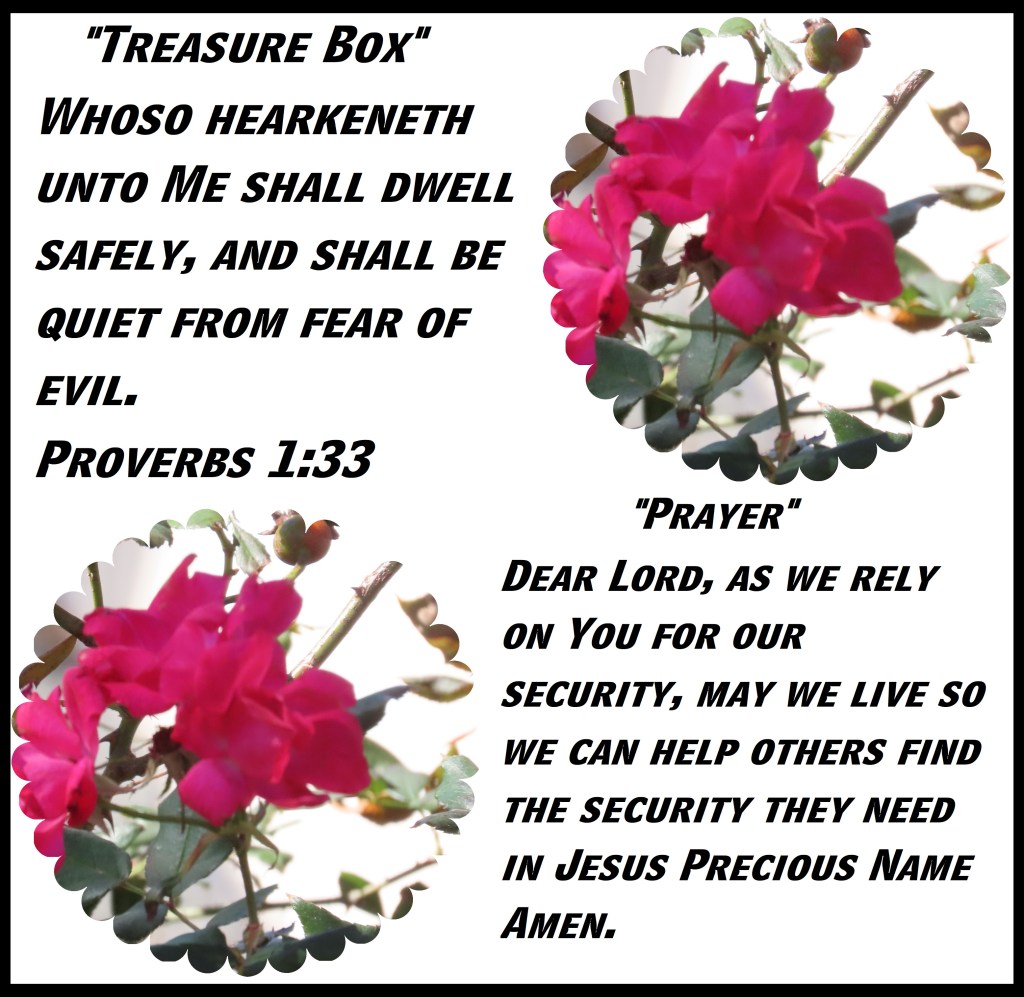
Whoso hearkened unto Me shall dwell safely and shall be quiet from fear of evil. Proverbs 1:33 “Prayer” Dear Lord, as we rely on You for our security, may we live so we can help others find the security they need in Jesus Precious Name Amen.
Bring joy to your servant, Lord, for I put my trust in you. You, Lord, are forgiving and good, abounding in love to all who call to you. Hear my prayer, Lord; listen to my cry for mercy. Psalm 86:4-6 NIV “Prayer” God, thank You for loving me for myself and dying that I might live. Teach me to feel that kind of love for others as well as myself. Bring joy out of all situations in Jesus Precious Name Amen.
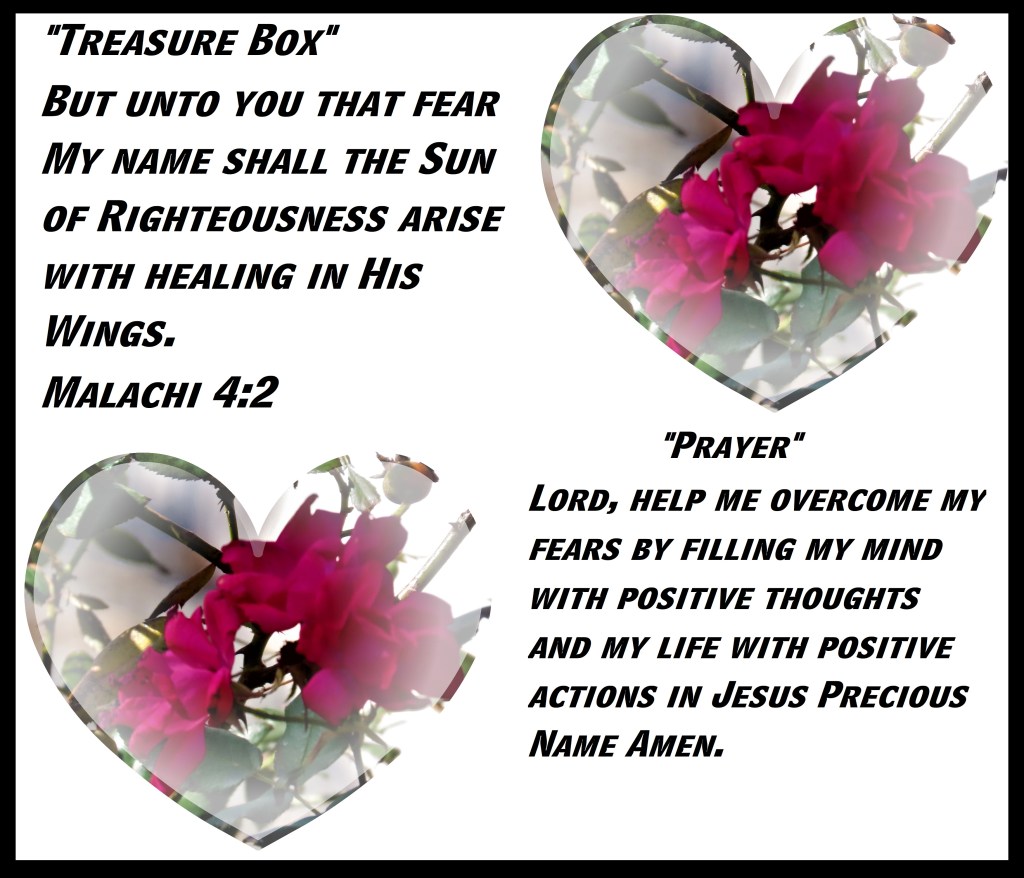
“Surely the day is coming; it will burn like a furnace. All the arrogant and every evildoer will be stubble, and the day that is coming will set them on fire,” says the Lord Almighty. “Not a root or a branch will be left to them. But for you who revere my name, the sun of righteousness will rise with healing in its rays. And you will go out and frolic like well-fed calves. Then you will trample on the wicked; they will be ashes under the soles of your feet on the day when I act,” says the Lord Almighty. Malachi 4:1-3 NIV “Prayer” Lord, forgive me when I fallen short. Help me overcome my fears by filling my mind with positive thoughts and my life with positive actions in Jesus Precious Name Amen.
Father God, I want to know more, let this touch someone’s heart today in Jesus Precious Name Amen. You know people will read romance novels or just read any kind of book and not put it down. Then some don’t even want to read the bible. The bible is a bunch of true stories of sinners, repenting, overcomers, saints and knowing Jesus.
I know my mother she was disabled, and she read books all the time. In fact, when we were growing up. I remember I had this winter coat with big pockets and because my dad was against her reading books. I would take and hide the books in my pockets. She would pay like .05 cents at a rummage sale. I would take them to my room and when my dad was gone, I would give them to her. My mom loved to read and took good care of us. She would tell us about her books. We would sit there and listen. Sometimes she wasn’t through with the book, and she would tell us how far she had reached, then let her go back and finish it so she could tell us what happened in the book. She would even write to the authors and tell them how she enjoyed the books, and they would write her back. When she passed. She had quite a few letters from authors. She always wanted to Teach others who couldn’t read. She did all her children, grandchildren and those who would listen. Our mom read the bible and it was no different than reading any book. Talks about sinners and people who repented and those who didn’t. Stories of true happenings back in the day. Our mom didn’t have a dusty bible.
I am fixing to jump around a bit with this today. If we didn’t read the bible, No one could say they knew for sure who Jesus was. Jesus’ own family thought he was delusional (Mark 3:21, But when His own people heard about this, they went out to lay hold of Him, for they said, “He is out of His mind.” NKJV). The religious leaders thought He was demon possessed. The political leaders thought He was John the Baptist raised from the dead. And the general population was divided in their opinion. In Christianity, Jesus is referred to as the Son of God, and in many major Christian denominations, he is referred to as God the Son, the second Person in the Triune Godhead. As the Jewish messiah, he is considered to be the fulfillment of prophecy contained throughout the Hebrew Bible. Jesus is calledthe Sonof God because He is God’s only begotten Son as revealed in John 3:16, For God so loved the world that He gave His only begotten Son, that whoever believes in Him should not perish but have everlasting life. Although Jesus had a human, legal father in Joseph and a human birth mother in Mary, he was and is the eternal Sonof God, the Alpha and the Omega, the beginning and the end. Jesus is precisely who He said He is – fully God and fully man. He is the Son of God and the second Person in the Trinity (Father, Son, and Holy Spirit). Jesus was crucified and raised from the dead to save all those who put their trust in Him. When we say Jesus Christ, the word “Christ” means “Messiah” (anointed one).
As Christians know and tell it, comes from the part of the Christian Bible called the “New Testament.” The first four books “Matthew, Mark, Luke, and John” are known as the “Gospels,” meaning “good news.” They were all written between about 70 and 100 CE, approximately two generations after the death of Jesus, and are based on stories of Jesus, told and retold by his followers. “Matthew, Mark “John Mark is an important person in the Gospels and the book of Acts. Paul also mentions him in Colossians and Philemon. Who was he? John Mark is the author of the second Gospel in the New Testament. He was a Jewish Christian from the city of Jerusalem. “What is the purpose of Mark’s Gospel? The gospels were written for an audience already Christian; their purpose was to strengthen the faith of those who already believed, not to convert unbelievers. The Gospel of Mark is all about action. Like all the other gospels of the Bible, it goes through Jesus’ life and death, but it also offers something a little different. It has its own lessons to teach us about Jesus, why he is important, and how he relates to our lives. Just so, why is the Gospel of Mark important? Mark’s is the first of the written gospels., and Luke are called the “synoptic” Gospels, because they present a “common view” of Jesus through many common sayings, parables, and events. Both Matthew and Luke seem to have used Mark’s Gospel in writing their own accounts. The Bible doesn’t have much to say about John Mark. Or any person named Mark. But it does tell us that someone named Mark was close to Peter and Paul, two of the most important leaders of the early Christian church. And the earliest sources we have tell us that despite his minor role in Scripture, this person called Mark John’s Gospel has a distinctive voice, focusing more on the divinity of Christ in the context of a cosmic worldview. The Gospels came out of early communities still struggling with their identity in a Jewish context. The traditional view is that the Gospel of Luke and Acts were written by the physician Luke, a companion of Paul. Many scholars believe him to be a Gentile Christian, though some scholars think Luke was a Hellenic Jew. These four authors of the Gospels – Matthew, Mark, Luke and John are known as the Evangelists. They are often represented with their attributes: the Angel for Saint Matthew, the Lion for Saint Mark, the Ox for Saint Luke and the Eagle for Saint John. Sometimes these symbols stand in for the Evangelists. These are the four authors: Matthew – a former tax collector (Levi) who was called by Jesus to be one of the Twelve Apostles, Mark – a follower of Peter and so an “apostolic man,” Luke – a doctor who wrote what is now the book of Luke to Theophilus. … John – a disciple of Jesus and the youngest of his Twelve Apostles. Now Jesus had 12 disciples and their names are It is common knowledge that Jesus Christ had 12 disciples or apostles. “The names of the 12 disciples of Jesus and a little bit about them”:
Peter was a typical Galilean. Among the twelve, Peter was the leader. He stands out as a spokesman for all the twelve Apostles. It is he who asked the meaning of the difficult saying in Matthew 15:15. It is he who asked how often he must forgive. It is he who inquired about the reward for all of those who follow Jesus. It is he who first confessed Jesus and declared Him as the Son of the Living God. It is he who was at the Mount of Transfiguration. It is he who saw Jairus’ daughter raised to life. Yet, it is he who denied Christ before a maiden. He was an Apostle and a missionary who laid down his life for his Lord. It is true, Peter had many faults, but he had always the saving grace of the loving heart. No matter how many times he had fallen and failed, he always recovered his courage and integrity. Peter was martyred on a cross. Peter requested that he might be crucified head downward for he was not worthy to die as his Lord had died. His apostolic symbol is a cross upside down with crossed keys.
Simon, the Zealot, the man who once would have killed in loyalty to Israel, became the man who saw that God will have no forced service. Tradition says he died as a martyr. His apostolic symbol is a fish lying on a Bible, which indicates he was a former fisherman who became a fisher of men through preaching. From this background, we see that Simon was a fanatical Nationalist, a man devoted to the Law, a man with bitter hatred for anyone who dared to compromise with Rome. Yet, Simon clearly emerged as a man of faith. He abandoned all his hatred for the faith that he showed toward his Master and the love that he was willing to share with the rest of the disciples and especially Matthew, the Roman tax collector.
Andre (Andre was Peter’s brother) Andrew ran to find his brother Simon Peter and told him that he had found the Messiah, which was being interpreted as the Christ. It was Andrew who brought Peter to Jesus. (John 1:37-42). Andrew was a fisherman with his brother Peter. According to tradition, it was in Achaia, Greece, in the town of Patra that Andrew died a martyr. When Governor Aepeas’ wife was healed and converted to the Christian faith, and shortly after that the Governor’s brother became a Christian. Aepeas was enraged. He arrested Andrew and condemned him to die on the cross. Andrew, feeling unworthy to be crucified on the same-shaped cross as his Master, begged that his be different. So, he was crucified on an X-shaped cross, which is still called Saint Andrew’s cross, and which is one of his apostolic symbols. A symbol of two crossed fish has also been applied to Andrew, because he was formerly a fisherman.
James ( James was the son of Zebedee) James and his brother John were the sons of Zebedee. They were Galilean fishermen whom Jesus called to follow him. James, along with Peter and John, was one of the disciples closest to Jesus. He was present at the Transfiguration, asked for a special place in Jesus’ kingdom, and accompanied Jesus in Gethsemane. He was a man of courage and forgiveness, a man without jealousy, living in the shadow of John, a man of extraordinary faith. He was the first of the twelve to become a martyr. His symbol is three shells, the sign of his pilgrimage by the sea.
John (Also a son of Zebedee and the brother of James) The Apostle John had the distinction of being a beloved friend of Jesus Christ, writer of five books of the New Testament, and a pillar in the early Christian church. John and his brother James, another disciple of Jesus, were fishermen on the Sea of Galilee when Jesus called them to follow him. John is traditionally regarded as the author of five books of the Bible: the Gospel of John, the epistles 1 John, 2 John, and 3 John, and the Book of Revelation, although some Bible scholars dispute which of these (if any) he actually wrote. He is also believed to be the only disciple who died of old age (the others were allegedly martyred). It is said that an attempt was made on his life by giving him a chalice of poison from which God spared him. He died of natural causes. A chalice with a snake in it is his symbol.
Philip (Philip the Apostle was one of the original twelve apostles. He came from Bethsaida in Galilee. Jesus invited Philip to become His disciple (John 1:43). Philip became the sixth disciple of Jesus and introduced his friend Nathanael (Bartholomew) to Jesus, who also became an apostle.) The Gospel of John shows Philip as one of the first to whom Jesus addressed the words, “Follow Me.” When Philip met Christ, he immediately found Nathanael and told him that “we have found him, of whom Moses … and the prophets, did write.” Nathanael was skeptical. But Philip did not argue with him; he simply answered, “Come and see.” This story tells us two important things about Philip. First, it shows his right approach to the skeptic and his simple faith in Christ. Second, it shows that he had a missionary instinct. Philip was a man with a warm heart and a pessimistic head. He was one who would very much like to do something for others, but who did not see how it could be done. Yet, this simple Galilean gave all he had. In return God used him. It is said that he died by hanging. While he was dying, he requested that his body be wrapped not in linen but in papyrus for he was not worthy that even his dead body should be treated as the body of Jesus had been treated. The symbol of Philip is a basket, because of his part in the feeding of the five thousand. It is he that stressed the cross as a sign of Christianity and victory.
Bartholomew (Bartholomew, one of Jesus’ Twelve apostles, discovered that Jesus knew him even before they had met for the first time. The apostle Philip brought Bartholomew, who is also called Nathanael in the Gospels, to Jesus, telling him that Jesus was the person the prophets spoke about, the promised one of God.) Bartholomew was one of the twelve apostles of Jesus. He has also been identified as Nathanael or Nathaniel, who appears in the Gospel of John when introduced to Jesus by Philip, although many modern commentators reject the identification of Nathanael with Bartholomew. The New Testament gives us very little information about him. Tradition indicates he was a great searcher of the Scripture and a scholar in the law and the prophets. He developed into a man of complete surrender to the Carpenter of Nazareth, and one of the Church’s most adventurous missionaries. He is said to have preached with Philip in Phrygia and Hierapolis; also in Armenia. The Armenian Church claims him as its founder and martyr. However, tradition says that he preached in India, and his death seems to have taken place there. He died as a martyr for his Lord. He was flayed alive with knives.
Matthew (Matthew served as one of the 12 disciples of Jesus Christ. As an eyewitness to the Savior, Matthew recorded a detailed account of Jesus’ life, the story of his birth, his message, and his many deeds in the Gospel of Matthew. He also served as a missionary, spreading the good news to other countries. Matthew was an accurate record keeper.) Matthew is the first book of the New Testament. While the author of the Gospel of Matthew is not identified, tradition has long assigned authorship to Matthew the apostle. Matthew was written to Greek-speaking Jewish Christians.
Thomas (Thomas is one of the six apostles whom Jesus visits at the sea of Galilee after His resurrection (John 21:2; John 21:3). When Luke lists the twelve, he couples Thomas with Matthew in his Gospel, and with Philip in the book of Acts (Luke 6:15; Acts 1:13). It’s possible that Thomas worked closely with these two apostles.) He is sometimes also referred to by his Greek name, Didymus. Both Thomas and Didymus mean “twin,” though the Bible never explicitly mentions him having a twin. By nature, Thomas was a pessimist. He was a bewildered man. Yet, he was a man of courage. He was a man who could not believe until he had seen. He was a man of devotion and of faith. When Jesus rose, he came back and invited Thomas to put his finger in the nail prints in his hands and in his side. Here, we see Thomas making the greatest confession of faith, “My Lord and my God.” Thomas’ doubts were transformed into faith. By this very fact Thomas’ faith became great, intense and convincing. It is said that he was commissioned to build a palace for the king of India, and he was killed with a spear as a martyr for his Lord. His symbol is a group of spears, stones and arrows.
James (Son of Alphaus)James son of Alphaeus was one of the twelve main disciples of Jesus Christ. The New Testament only mentions him in the four lists of disciples, and always toward the end, indicating he was less important than the others. James’s son of Alphaeus is traditionally identified as James the Less and James the brother of Jesus. According to tradition he wrote the Epistle of James, preached in Palestine and Egypt and was crucified in Egypt. James was one of the little-known disciples. Some scholars believe he was the brother of Matthew, the tax collector. James was a man of strong character and one of the fieriest type. Still another tradition says that he died as a martyr and his body was sawed in pieces. The saw became his apostolic symbol.
Simon, the Zealot, the man who once would have killed in loyalty to Israel, became the man who saw that God will have no forced service. Tradition says he died as a martyr. His apostolic symbol is a fish lying on a Bible, which indicates he was a former fisherman who became a fisher of men through preaching. (The Apostle Peter (also known as Saint Peter, Simon Peter, and Cephas) was one of the 12 main disciples of Jesus Christ, and along with James and John, he was one of Jesus’ closest companions. After the resurrection, Peter became one of the most influential Christian leaders in the first century, and according to Catholic tradition, he was also the first pope.)
Jude, Thaddeus, or Lebbeus, son of Alpheus or Cleophas and Mary. He was a brother of James the Younger. He was one of the very little-known Apostles and lived in Galilee. It is said that Jude went to preach the gospel in Edessa near the Euphrates River. There he healed many and many believed in the name of the Master. Jude went from there to preach the Gospel in other places. He was killed with arrows at Ararat. The chosen symbol for him is the ship because he was a missionary thought to be a fisherman. Tradition says he preached in Assyria and Persia and died a martyr in Persia.
(Judas Iscariot was one of the 12 apostles of Jesus Christ. He infamously betrayed Jesus for 30 pieces of silver, which lead to his death on the cross. Today, “Judas” is virtually synonymous for “traitor.”Among the disciples, Judas was the official treasurer, and he was apparently pretty shady even before he made his big debut as the worst person in history. (He stole money.) Despite that, Judas was a fairly conflicted person. He tried to return the 30 pieces of silver, and according to the Gospel of Matthew, he hanged himself not long after betraying Jesus.)Did Jesus forgive Judas I wondered: No, Judas was not forgiven for his betrayal of Jesus — and one reason is because he could not bring himself to repent of the sin he had committed. You see, there’s a difference between feeling sorry over something we have done, and actually repenting of it. So Judas guilt Judas Iscariot ( He is notoriously known since time immemorial of betraying Jesus Christ)
The Gospel of Matthew, for instance, is most conscious of the debates within Judaism after the destruction of the Temple in 70 CE, while the Gospel of John shows signs of Christians being thrown out from the synagogues. Although the Gospels differ in their accounts of Jesus’ life and ministry, sometimes in remarkable ways, the early church did not blend them into one account, but preserved these four distinct Gospels, with their differences. Together they provide four views of the life and teachings of Jesus. According to the traditions of Luke and Matthew, Jesus was born in Bethlehem in Judaea in the ancestry of King David. Theirs is a story in which the ordinary and the miraculous intertwine. The mother of Jesus is said to be Mary, who became pregnant to Jesus by the power of the Holy Spirit while she was still a young unmarried virgin; Joseph, her fiancé, was a carpenter from Nazareth. Luke’s story is familiar to Christians throughout the world: the couple traveled to Bethlehem to be counted in the census and finding no room at the local inn, had to stay in a stable. Jesus was born that night, his first bed a manger filled with hay. Nearby shepherds with their flocks heard angels singing and hurried to see the newborn child. Matthew says nothing of the stable or the shepherds, but tells of wise men or astrologers, who saw the light of a star and came from the East bringing gifts to honor the child. Mark and John leave out the birth story altogether, with Mark beginning his account with the baptism of Jesus, and John with the creation of the cosmos. (It reads in Mark 1:9-11, ESV “The Baptism of Jesus. In those days Jesus came from Nazareth of Galilee and was baptized by John in the Jordan. And when he came up out of the water, immediately he saw the heavens being torn open and the Spirit descending on him like a dove. And a voice came from heaven, “You are my beloved Son; with you I am well pleased.”) So, How Old Was Jesus When He Got Baptized? The Bible doesn’t give us a specific age for when Jesus was baptized, but it did mention in Luke 3:23 that Jesus was “about thirty years old” at the time. So, based on what we know from the Bible, it’s safe to say that Jesus was probably in His late twenties to mid-30s when He got baptized. If you can remember after Jesus was born Joseph and Mary took baby Jesus to the temple for a dedication (Luke 2:22 ESV, and when the time came for their purification according to the Law of Moses, they brought him up to Jerusalem to present him to the Lord), A common practice under the Jewish law. Common Bible verses heard at a baby dedication usually include Psalm 127:3: “Behold, children are a heritage from the LORD, the fruit of the womb a reward. “The lifetime of Jesus is called (literally translated) “the days of his flesh” which would be inappropriate if he were not flesh (Hebrews 5:7-8, In the days of his flesh, Jesus offered up prayers and supplications, with loud cries and tears, to him who was able to save him from death, and he was heard because of his reverence. Although he was a son, he learned obedience through what he suffered.) The docetist argues that Jesus was “in appearance as a man” and was “made in human likeness” (Philippians 2:7-8, but made himself nothing, taking the form of a servant, being born in the likeness of men. And being found in human form, he humbled himself by becoming obedient to the point of death, even death on a cross.) But far from proving that he was not truly human, and only seemed to be, this proves that he was indeed human.
I am certain that my husband is a human being of flesh, only because I and others can touch him and see that he has every appearance of human flesh and human nature. If I disbelieved this evidence and claimed that my husband was really a ghost or an angel or a coconut masquerading as a human being, you would call for the men in white coats. “Let’s Pray” Lord, I thank you that neither death nor life, nor angels nor rulers, nor things present nor things to come, nor powers, nor height nor depth, nor anything else in all creation will be able to separate us from the love of God in Christ Jesus our Lord. – Romans 8:38-39
“Power Verses”
Go therefore and make disciples of all nations, baptizing them in the name of the Father and of the Son and of the Holy Spirit, teaching them to observe all that I have commanded you. And behold, I am with you always, to the end of the age.” Matthew 28:19-20 ESV
“Loving God, take pity on me, a sinner. I believe in You and that Your word is true. Father God, I accept that Jesus Christ is the Son of the Mighty God and that he died on the cross so that I may now have forgiveness for my sins and eternal life. Lord, I acknowledge that without you in my heart my life is meaningless in Jesus Name Amen.