Question: How did Jeremiah work with his secretary? Answer: Baruch ben Neriah (Hebrew: בָּרוּךְ בֶּן־נֵרִיָּה Bārūḵ ben Nērīyyā; c. 6th century BC) was the scribe, disciple, secretary, and devoted friend of the Biblical prophet Jeremiah. He is traditionally credited with authoring the Book of Baruch. Baruch wrote upon a scroll at the dedication of Jeremiah all the words of the Lord which he had spoken to him. Isaiah 36:4 KJV: And Rabshakeh said unto them, Say ye now to Hezekiah, Thus saith the great king, the king of Assyria, What confidence is this wherein thou trustest? Isaiah 45:1 KJV:Thus saith the Lord to his anointed, to Cyrus, whose right hand I have holden, to subdue nations before him; and I will loose the loins of kings, to open before him the two leaved gates; and the gates shall not be shut; Jeremiah said: “I am debarred from going to the house of the Lord; so you are to go and in the hearing of all the people you shall read the words of the Lord from the scroll which you have written at my dictations. Isaiah 36:6 KJV> Lo, thou trustest in the staff of this broken reed, on Egypt; whereon if a man lean, it will go into his hand, and pierce it: so is Pharaoh king of Egypt to all that trust in him.
Question: Why do we know more about Jeremiah and his inner life than any other prophet? Answer: Jeremiah, Hebrew Yirmeyahu, Latin Vulgate Jeremias, (born probably after 650 BCE, Anathoth, Judah—died c. 570 BCE, Egypt), Hebrew prophet, reformer, and author of a biblical book that bears his name. He was closely involved in the political and religious events of a crucial era in the history of the ancient Near East; his spiritual leadership helped his fellow countrymen survive disasters that included the capture of Jerusalem by the Babylonians in 586 BCE and the exile of many Judaeans to Babylonia. In the book of Jeremiah reveal a strong conflict between Jeremiah’s natural inclinations and his deep sense of vocation to deliver Yahweh’s message to the people. Jeremiah was by nature sensitive, introspective, and perhaps shy. He was denied participation in the ordinary joys and sorrows of his fellowmen and did not marry. He thus could say, “I sat alone,” with God’s hand upon him. Jeremiah had periods of despondency when he expressed the wish that he had never been born or that he might run away and live alone in the desert. He reached the point of calling God “a deceitful brook,…waters that fail” and even accused God of deceiving and overpowering him. Yet there were times of exaltation when he could say to God, “Thy words became to me a joy and the delight of my heart,” and he could speak of Yahweh as “a dread warrior” fighting by his side. We have not only his own sermons and memoirs, sometimes called the confession of Jeremiah, but also biography materials assembled and set down on his secretary, Baruch.
Question: What is known of Jeremiah’s childhood and youth?
Answer:
Jeremiah identifies himself 1:1 KJV. The words of Jeremiah the son of Hilkiah, of the priests that were in Anathoth in the land of Benjamin: “Jeremiah 1:4-5 KJV> suggests predestination: Then the word of the Lord came unto me, saying, Before I formed thee in the belly I knew thee; before thou camest forth out of the womb I sanctified thee, and I ordained thee a prophet unto the nations.
Question: How does Jeremiah date his ministry? Answer:
It reads in Jeremiah 1:1-3 KJV> The words of Jeremiah the son of Hilkiah, of the priests that were in Anathoth in the land of Benjamin: To whom the word of the Lord came in the days of Josiah the son of Amon king of Judah, in the thirteenth year of his reign. It came also in the days of Jehoiakim the son of Josiah king of Judah, unto the end of the eleventh year of Zedekiah the son of Josiah king of Judah, unto the carrying away of Jerusalem captive in the fifth month. So, Jeremiah began his ministry in 626 B.C., the thirteenth year of the reign of King Josiah. He continued to preach until after the downfall of Jerusalem in approximately 586 B.C. His ministry ended sometime around 582 BC with his prophecy to the Jews who fled to Egypt.
Question: Who was Jeremiah? Answer: Jeremiah was a Hebrew prophet, reformer, and author of a biblical book that bears his name. He was born probably after 650 BCE in Anathoth, Judah, and died around 570 BCE in Egypt. A prophet who foresaw and witnessed the destruction of Jerusalem by the Babylonians in 586 B.C.. In addition to his book of prophecy, he is also credited with writing the Books of Kings and Lamentations. He was called to prophesy around 626 BCE, and we know more about his life than any other prophet. According to the biblical Book of Jeremiah, he began his prophetic career in 627/626—the 13th year of King Josiah’s reign. It is told there that he responded to Yahweh’s (God’s) call to prophesy by protesting “I do not know how to speak, for I am only a youth,” but he received Yahweh’s assurance that he would put his own words into Jeremiah’s mouth and make him a “prophet to the nations.” A few scholars believe that after his call Jeremiah served as an official prophet in the Temple, but most believe that this is unlikely in view of his sharp criticism of priests, prophets, and the Temple cult. Question: Does BCE count backward? Answer: Yes, BCE is counted backward because it is a retrospective calendar with the start point at year 1 of the Gregorian calendar and must therefore count backward in order to make any sense, just like negative numbers. BCE/CE is a secular reskinning of BC/AD, and it uses the same date as the starting point for when to count forward and when to count backward, meaning the date is the same whether you use the secular or Christian abbreviation. The dating system was created before zero was in common use, so it jumps from 1 BC (or 1 BCE) to 1 AD (or 1 CE).
Question: Jeremiah 29:13 represents God as saying: “When you seek me with all your heart, I will be found by You.” “How does Isaiah phrase the complementary truth? Answer: “I am sought of them that asked not for me; I am found of them that sought me not: I said, Behold me, behold me, unto a nation that was not called by my name.” Isaiah 65:1 KJV
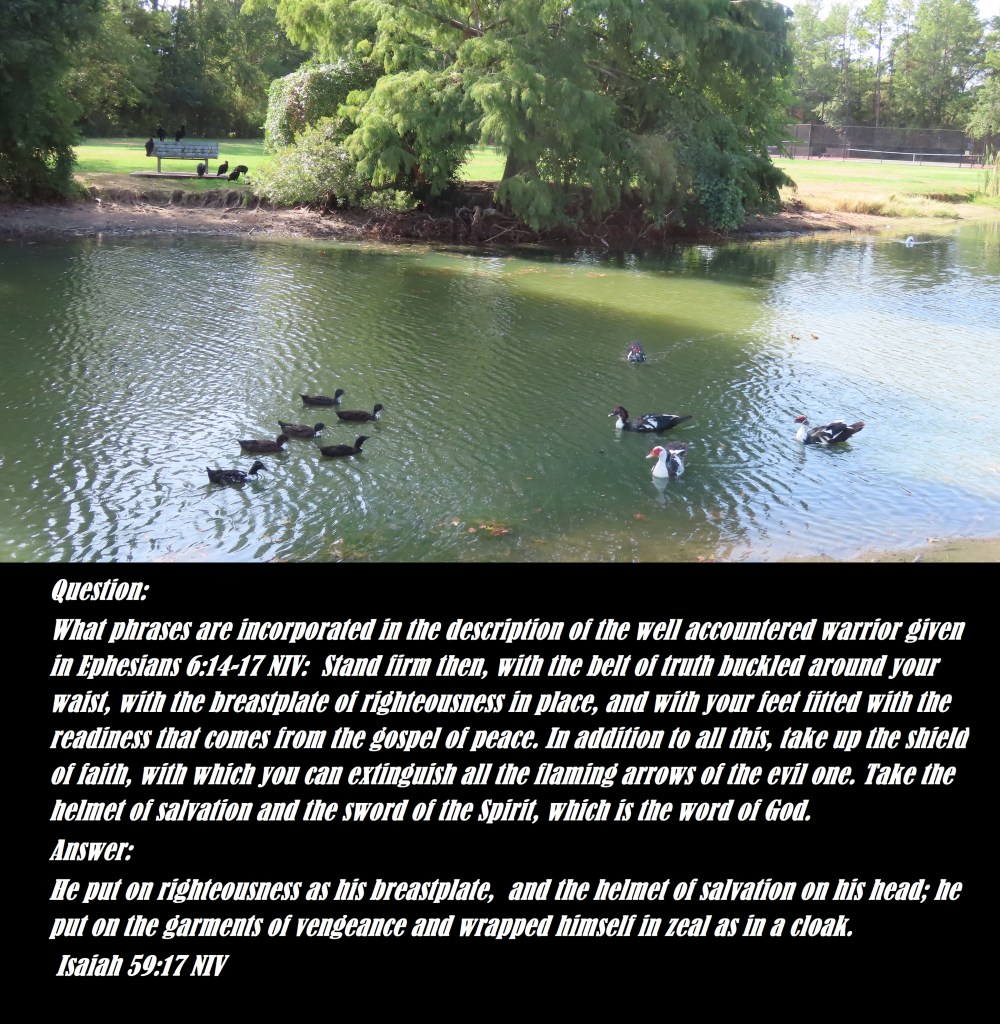
Question: What phrases are incorporated in the description of the well-accounted warrior given in Ephesians 6:14-17 NIV: Stand firm then, with the belt of truth buckled around your waist, with the breastplate of righteousness in place, and with your feet fitted with the readiness that comes from the gospel of peace. In addition to all this, take up the shield of faith, with which you can extinguish all the flaming arrows of the evil one. Take the helmet of salvation and the sword of the Spirit, which is the word of God. Answer: He put on righteousness as his breastplate, and the helmet of salvation on his head; he put on the garments of vengeance and wrapped himself in zeal as in a cloak. Isaiah 59:17 NIV
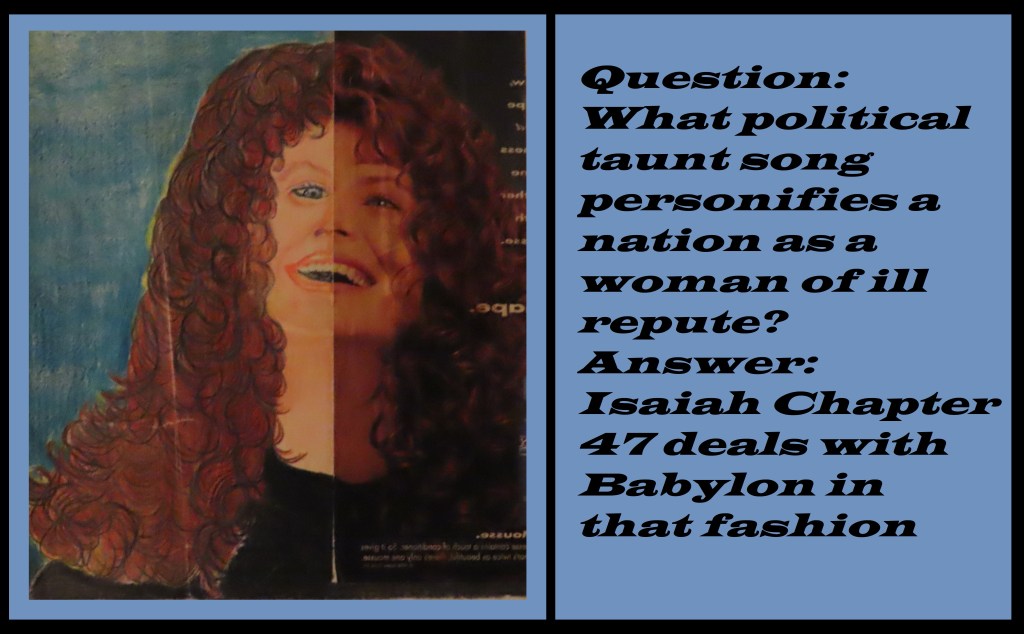
Question: What political taunt song personifies a nation as a woman of ill repute? Answer: Isaiah Chapter 47 deals with Babylon in that fashion this is what it reads: “Come down and sit in the dust, Virgin daughter of Babylon; Sit on the ground without a throne, Daughter of the Chaldeans! For you will no longer be called tender and delicate. Take the millstones and grind flour. Remove your veil, strip off the skirt, Uncover the leg, and cross the rivers. Your nakedness will be uncovered, and your shame will also be exposed; I will take vengeance and will not spare anyone.” Our Redeemer, the Lord of armies is His name, The Holy One of Israel. “Sit silently, and go into darkness, Daughter of the Chaldeans; For you will no longer be called The queen of kingdoms. I was angry with My people, I profaned My heritage And handed them over to you. You did not show mercy to them, On the aged you made your yoke very heavy. Yet you said, ‘I will be a queen forever.’ These things you did not consider Nor remember the outcome of them. “Now, then, hear this, you luxuriant one, Who lives securely, Who says in her heart, ‘I am, and there is no one besides me. I will not sit as a widow, Nor know the loss of children.’ But these two things will come on you suddenly in one day: Loss of children and widowhood. They will come on you in full measure In spite of your many sorceries,In spite of the great power of your spells. You felt secure in your wickedness and said, ‘No one sees me,’ Your wisdom and your knowledge, they have led you astray; For you have said in your heart, ‘I am, and there is no one besides me.’ But evil will come on you Which you will not know how to charm away; And disaster will fall on you For which you cannot atone; And destruction about which you do not know Will come on you suddenly. “Persist now in your spells And in your many sorceries With which you have labored from your youth; Perhaps you will be able to benefit, Perhaps you may cause trembling. You are wearied with your many counsels; Let now the astrologers, Those who prophesy by the stars, Those who predict by the new moons, Stand up and save you from what will come upon you. Behold, they have become like stubble, Fire burns them; They cannot save themselves from the power of the flame; There will be no coal to warm by Nor a fire to sit before! So have those become to you with whom you have labored, Those who have done business with you from your youth; Each has wandered in his own way; There is no one to save you.
Question: What song of Thanksgiving is attributed to King Hezekiah, recuperating from illness? Answer: I said, “In the middle of my life. I am to enter the gates of Sheol; I have been deprived of the rest of my years.” I said, “I will not see the Lord, The Lord in the land of the living; I will no longer look at mankind among the inhabitants of the world. Like a shepherd’s tent my dwelling is pulled up and removed from me; As a weaver I rolled up my life. He cuts me off from the loom; From day until night You make an end of me. I composed my soul until morning. Like a lion—so He breaks all my bones, From day until night, You make an end of me. Like a swallow, like a crane, so I twitter; I moan like a dove; My eyes look wistfully to the heights; Lord, I am oppressed, be my security. “What shall I say? For He has spoken to me, and He Himself has done it; I will walk quietly all my years because of the bitterness of my soul. Lord, by these things people live, And in all these is the life of my spirit; Restore me to health and let me live! Behold, for my own welfare I had great bitterness; But You have kept my soul from the pit of nothingness, For You have hurled all my sins behind Your back. For Sheol cannot thank You, Death cannot praise You; Those who go down to the pit cannot hope for Your faithfulness. It is the living who give thanks to You, as I do today; A father tells his sons about Your faithfulness. The Lord is certain to save me; So we will play my songs on stringed instruments All the days of our life at the house of the Lord.” Isaiah 38:10-20 NASB
Question: What passage poses the philosopher’s problem? Answer: “To whom then will you liken God?” Or what likeness will you compare with Him? Isaiah 40:18 NASB