Question: What is the duty of the believing citizen? Answer: Give to everyone what you owe them: If you owe taxes, pay taxes; if revenue, then revenue; if respect, then respect; if honor, then honor. Romans 13:7-11 One in authority is God’s servant for your good. If you do wrong, be afraid, for rulers do not bear the sword for no reason. They are God’s servants, agents of wrath to bring punishment on the wrongdoer. Therefore, it is necessary to submit to the authorities, not only because of possible punishment but also as a matter of conscience.
Answer: Based on scriptural texts, Paul appears to be a ideal conservative — not in the contemporary American sense of favoring a smaller government, but in the more traditional political sense of not wanting to disrupt the established order. Indeed, contemporary progressives reject Paul’s unwillingness to challenge the social status quo. It reads in Romans 13:1-3 NIV: Let everyone be subject to the governing authorities, for there is no authority except that which God has established. The authorities that exist have been established by God. Consequently, whoever rebels against the authority is rebelling against what God has instituted, and those who do so will bring judgment on themselves. For rulers hold no terror for those who do right, but for those who do wrong. Do you want to be free from fear of the one in authority? Then do what is right and you will be commended. Paul strongly argued that we are “justified by faith in Christ (or “the faith of Christ”) and not by doing the works of the law”(Galatians 2:16 NIV: know that a person is not justified by the works of the law, but by faith in Jesus Christ. So, we, too, have put our faith in Christ Jesus that we may be justified by faith in Christ and not by the works of the law, because by the works of the law no one will be justified.)
Question: What striking figures of speech appear in Paul’s letter? Answer: The potter and the clay. {“Romans 9:19-21 NIV: One of you will say to me: “Then why does God still blame us? For who is able to resist his will?” But who are you, a human being, to talk back to God? “Shall what is formed say to the one who formed it, ‘Why did you make me like this?’” Does not the potter have the right to make out of the same lump of clay some pottery for special purposes and some for common use?”} Suggest God’s providential ordering of human life; the grafting of a wild olive shoot. {“Romans 11:17-24 NIV: “If some of the branches have been broken off, and you, though a wild olive shoot, have been grafted in among the others and now share in the nourishing sap from the olive root, do not consider yourself to be superior to those other branches. If you do, consider this: You do not support the root, but the root supports you. You will say then, “Branches were broken off so that I could be grafted in.” Granted. But they were broken off because of unbelief, and you stand by faith. Do not be arrogant, but tremble. For if God did not spare the natural branches, he will not spare you either. Consider therefore the kindness and sternness of God: sternness to those who fell, but kindness to you, provided that you continue in his kindness. Otherwise, you also will be cut off. And if they do not persist in unbelief, they will be grafted in, for God is able to graft them in again. After all, if you were cut out of an olive tree that is wild by nature, and contrary to nature were grafted into a cultivated olive tree, how much more readily will these, the natural branches, be grafted into their own olive tree! }” Suggests how God can be kind to all: “The armor of light”must be replace “the works of darkness.” {Romans 13:11-14 NIV: And do this, understanding the present time: The hour has already come for you to wake up from your slumber, because our salvation is nearer now than when we first believed. The night is nearly over; the day is almost here. So let us put aside the deeds of darkness and put on the armor of light. Let us behave decently, as in the daytime, not in carousing and drunkenness, not in sexual immorality and debauchery, not in dissension and jealousy. Rather, clothe yourselves with the Lord Jesus Christ, and do not think about how to gratify the desires of the flesh.}
Question: What Philosophy of suffering is set forth?
Answer: “I consider that our present sufferings are not worth comparing with the glory that will be revealed in us. Romans 8:18 NIV” And we know that in all things God works for the good of those who love him, who have been called according to his purpose. Romans 8:28 NIV
Question: What autobiographical touches appear in this letter? Answer: In Romans 7:15-20 the author gives a frank picture of a tortured inner self; “I do not understand my own actions”; in Romans 11:1, he recounts his ancestry: “an Israelite, a descendant of Abraham, a member of the tribe of Benjamin”; in Romans 15:21 he tells us that it was his policy to seek out places where Jesus Christ had not yet preached, “Lest I build on another man’s foundation.”
It reads in Romans 7:15-20 NIV: I do not understand what I do. For what I want to do I do not do, but what I hate I do. And if I do what I do not want to do, I agree that the law is good. As it is, it is no longer I myself who do it, but it is sin living in me. For I know that good itself does not dwell in me, that is, in my sinful nature. For I have the desire to do what is good, but I cannot carry it out. For I do not do the good I want to do, but the evil I do not want to do, this I keep on doing. Now if I do what I do not want to do, it is no longer I who do it, but it is sin living in me that does it. It reads in Romans 11:1 NIV: I ask then: Did God reject his people? By no means! I am an Israelite myself, a descendant of Abraham, from the tribe of Benjamin. It reads in Romans 15:21 NIV: Rather, as it is written: “Those who were not told about him will see, and those who have not heard will understand.”
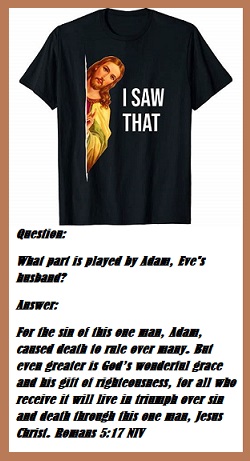
Question: What part is played by Adam, Eve’s husband? Answer: For the sin of this one man, Adam, caused death to rule over many. But even greater is God’s wonderful grace and his gift of righteousness, for all who receive it will live in triumph over sin and death through this one man, Jesus Christ. Romans 5:17 NIV
Question: What is the answer of God’s love for us? Answer: The love of God is the sure foundation of our faith in Him. God’s love gives us the absolute assurance that we are never alone or without help. God’s love for us is unfailing, it never stops, it is eternal. God’s love is the reason we are alive. “Very rarely will anyone die for a righteous person, though for a good person someone might possibly dare to die. But God demonstrates his own love for us in this: While we were still sinners, Christ died for us. Romans 5:7-8 NIV
Question: What position is assigned to Jesus Christ? Answer: Let us look at the fact here presented to us, or at THE POSITION ASSIGNED TO JESUS CHRIST. He is said to be seated “at the right hand of the throne of God.” A place at the right hand of any person in authority and power is employed by the Sacred Writers to represent a position of high honor. Through whom we have gained access by faith into this grace in which we now stand. And we boast in the hope of the glory of God. Romans 5:2 NIV: “Death no longer has dominion over Christ.”Romans 6:9 NIV: For we know that since Christ was raised from the dead, he cannot die again; death no longer has mastery over him.
Question: How is justification now obtained? Answer: It reads in Romans 5:1-2 : “Therefore, since we are justified BY and THROUGHFAITH, we have peace with God through our Lord Jesus Christ. Through him we have obtained access to this grace in which we stand, and we rejoice in our hope of sharing the glory of God.”
Question: Didn’t Abraham obey the spirit of the law?
Answer: Abraham stood righteous before God, even before the Ten Commandments were given. His righteousness was counted to him strictly from his faith, not from his works (observation of law). It reads in Romans 4:13 NIV It was not through the law that Abraham and his offspring received the promise that he would be heir of the world, but through the righteousness that comes by faith.




 "Only Life Changes"