Question: What reasons in the book of Isaiah itself for speaking of a school of prophets under the leadership of Isaiah? Answer: Isaiah 8:16 says, “Bind up the testimony, seal the law among my disciples.” According to some commentaries, this verse is spoken by God the Father and refers to the word of God, especially the doctrine of the Messiah. The expressions “bind up” and “seal” are understood prophetically, meaning that the doctrine shall be bound up and sealed. This can be interpreted as meaning that the doctrine will be secure and preserved among Isaiah’s disciples, but also kept secret and hidden from others until its fulfillment.
Question: What reasons are there for concluding that the work of more than one man is contained in the present book of Isaiah? Answer: There are different theories and approaches to the question of the authorship of the book of Isaiah. Some scholars believe that the book contains the work of one prophet, Isaiah ben Amoz, who lived in the 8th century BCE and prophesied about the events of his time and the future. Others argue that the book is a composite of different authors who wrote in different historical periods and contexts, reflecting the changing circumstances of Judah and Israel. The most common division is into three sections: Proto-Isaiah (chapters 1-39), Deutero-Isaiah (chapters 40-55), and Trito-Isaiah (chapters 56-66), each attributed to a different author or group of authors.
Some of the reasons for concluding that the book of Isaiah has more than one author are:
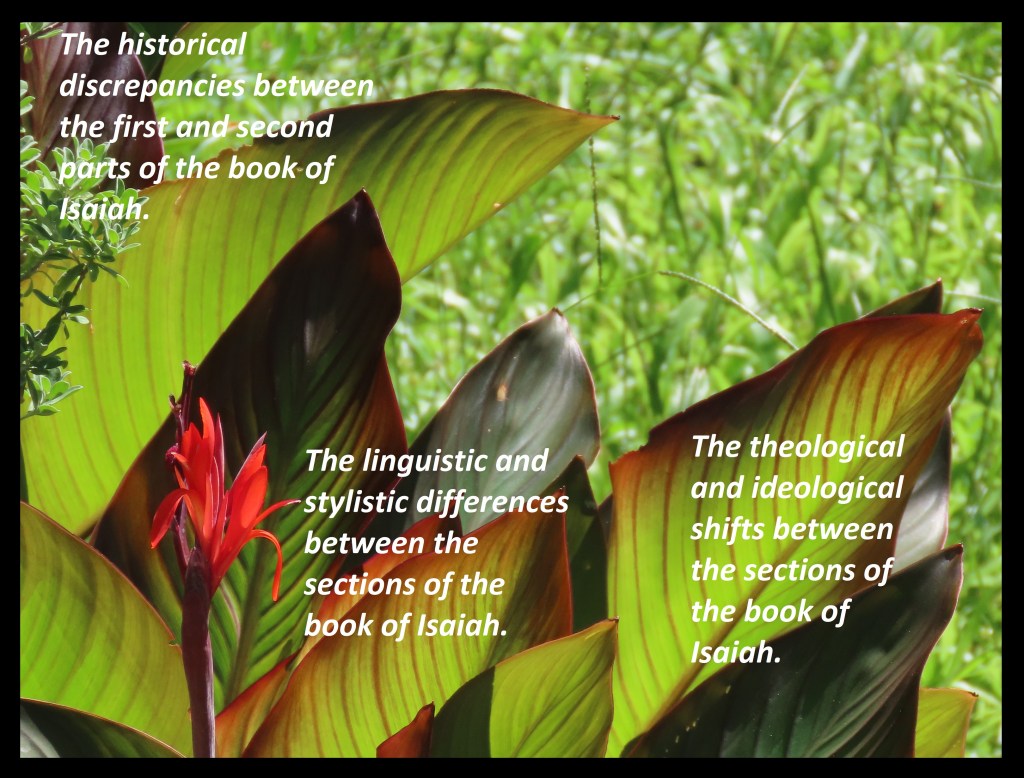
The historical discrepancies between the first and second parts of the book of Isaiah.
The first part (chapters 1-39) deals with the Assyrian threat and the fall of Samaria in the 8th century BCE, while the second part (chapters 40-55) addresses the Babylonian exile and the rise of Cyrus the Great in the 6th century BCE. The third part (chapters 56-66) seems to reflect the situation after the return from exile in the 5th century BCE. It is unlikely that one prophet could have foreseen such distant events with such accuracy and detail.
The linguistic and stylistic differences between the sections of the book of Isaiah.
The vocabulary, grammar, syntax, and literary devices used in each section vary significantly, suggesting different authors or schools of thought. For example, Deutero-Isaiah uses more Aramaic words and expressions than Proto-Isaiah, indicating a later date of composition.
The theological and ideological shifts between the sections of the book of Isaiah.
The first part (chapters 1-39) emphasizes God’s judgment on Judah and Israel for their sins and idolatry, while the second part (chapters 40-55) focuses on God’s comfort and salvation for his suffering people. The third part (chapters 56-66) deals with the challenges and hopes of the restored community in Jerusalem. The concept of God also changes from a national deity to a universal sovereign, and the role of the Messiah becomes more prominent in Deutero-Isaiah.
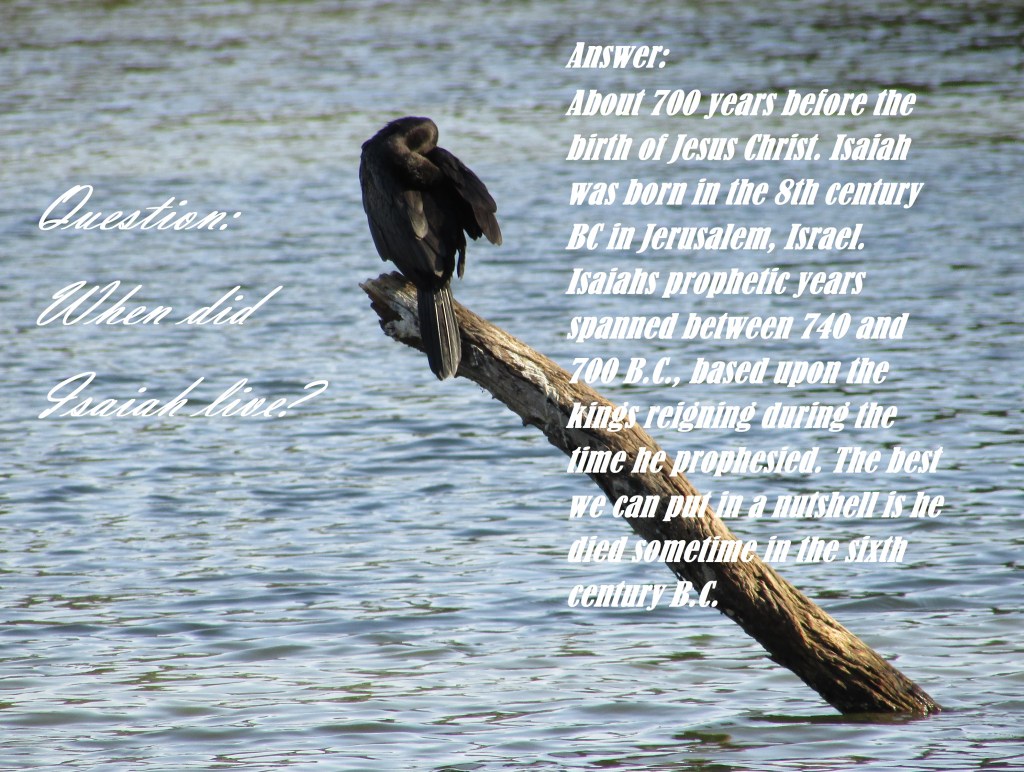
Question: When did Isaiah live? Answer: About 700 years before the birth of Jesus Christ. Isaiah was born in the 8th century BC in Jerusalem, Israel. Isaiahs prophetic years spanned between 740 and 700 B.C., based upon the kings reigning during the time he prophesied. The best we can put in a nutshell is he died sometime in the sixth century B.C.
Question: Who was Isaiah? Answer: Isaiah was a prophet of God who lived in Jerusalem about 700 years before Jesus Christ. He saw a vision that made him a prophet and prophesized the coming of the Messiah Jesus Christ. (The vision concerning Judah and Jerusalem that Isaiah was the son of Amoz saw during the reigns of Uzziah, Jotham, Ahaz and Hezekiah, kings of Judah. Isaiah 1:1 NIV) Isaiah, the son of Amoz, was a member of the royal family. He made his first public appearance as the Divinely inspired prophet in the year of Uzziah ‘s affliction with leprosy. That was in the year 3142 (Jewish year) after Creation. He wrote the book of Isaiah in the Bible, which has 66 chapters and is a key message of God’s covenant with Israel. Isaiahs’s name means “Salvation of the Lord” “the Lord saves”. He was a significant contributor to Jewish and Christian traditions and was quoted by Jesus and others in the New Testament.
Question: Who was Isaiah? Answer: Isaiah was a prophet of God who lived in Jerusalem about 700 years before Jesus Christ. He saw a vision that made him a prophet and prophesized the coming of the Messiah Jesus Christ. (The vision concerning Judah and Jerusalem that Isaiah was the son of Amoz saw during the reigns of Uzziah, Jotham, Ahaz and Hezekiah, kings of Judah. Isaiah 1:1 NIV) Isaiah, the son of Amoz, was a member of the royal family. He made his first public appearance as the Divinely inspired prophet in the year of Uzziah ‘s affliction with leprosy. That was in the year 3142 after Creation. He wrote the book of Isaiah in the Bible, which has 66 chapters and is a key message of God’s covenant with Israel. Isaiahs’s name means “Salvation of the Lord” “the Lord saves”. He was a significant contributor to Jewish and Christian traditions and was quoted by Jesus and others in the New Testament. What’s the difference between Jewish year and reg year? A year in the Hebrew calendar can be 353, 354, 355, 383, 384, or 385 days long. Regular common years have 12 months with a total of 354 days. Leap years have 13 months and are 384 days long. Months with uneven numbers usually have 30 days, while months with even numbers have 29 days.
Question: What are some remarkable passages in Romans, and it sustains the child of God? Answer: It reads in Romans 14:23 NIV. But whoever has doubts is condemned if they eat, because their eating is not from faith; and everything that does not come from faith is sin. It reads in Romans 15:1 NIV. We who are strong ought to bear with the failings of the weak and not to please ourselves. The book of Romans is a book to be of obedience and knowledge of being a child of God. The book of Romans is carefully constructed summary of Christian theology. Paul’s explanation of God’s plan of salvation by grace, through faith in Jesus Christ. Romans provides the fundamentals about the Gospel and the plan of God that are essential for every Church Age believer to master. Assisting us to comprehend the basic tenants of the faith we believe and is important to base everything we do as Christians around the Gospel of Jesus Christ.
Question: What are some remarkable passages in Romans? Answer: It reads in Romans 14:7 NIV. For none of us lives for ourselves alone, and none of us dies for ourselves alone. It reads in Romans 14:19 NIV. Let us therefore make every effort to do what leads to peace and to mutual edification.
Question: What are some remarkable passages in Romans? Answer: It reads in Romans 10:12-13 NIV. For there is no difference between Jew and Gentile, the same Lord is Lord of all and richly blesses all who call on him, for, “Everyone who calls on the name of the Lord will be saved.” It reads in Romans 11:33 NIV. Oh, the depth of the riches of the wisdom and knowledge of God! How unsearchable his judgments, and his paths beyond tracing out! It reads in Romans 12:2 NIV. Do not conform to the pattern of this world, but be transformed by the renewing of your mind. Then you will be able to test and approve what God’s will is his good, pleasing and perfect will.
Question: What are some remarkable passages in Romans? Answer: It reads in Romans 8:14 NIV. For those who are led by the Spirit of God are the children of God. It reads in Romans 8:31-39 NIV. What, then, shall we say in response to these things? If God is for us, who can be against us? He who did not spare his own Son, but gave him up for us all, how will he not also, along with him, graciously give us all things? Who will bring any charge against those whom God has chosen? It is God who justifies. Who then is the one who condemns? No one. Christ Jesus who died, more than that, who was raised to life, is at the right hand of God and is also interceding for us. Who shall separate us from the love of Christ? Shall trouble or hardship or persecution or famine or nakedness or danger or sword? As it is written: “For your sake we face death all day long; we are considered as sheep to be slaughtered.” No, in all these things we are more than conquerors through him who loved us. For I am convinced that neither death nor life, neither angels nor demons, neither the present nor the future, nor any powers, neither height nor depth, nor anything else in all creation, will be able to separate us from the love of God that is in Christ Jesus our Lord.
Question: What are some remarkable passages in Romans?
Answer: It reads in Romans 2:9-12 NIV. There will be trouble and distress for every human being who does evil: first for the Jew, then for the Gentile; but glory, honor and peace for everyone who does good: first for the Jew, then for the Gentile. For God does not show favoritism. All who sin apart from the law will also perish apart from the law, and all who sin under the law will be judged by the law. It reads in Romans 6:23 NIV. For the wages of sin is death, but the gift of God is eternal life in Christ Jesus our Lord.
Question: On matters of conscience, what is to be the believer’s attitude toward others? Answer:
Therefore let us stop passing judgment on one another. Instead, make up your mind not to put any stumbling block or obstacle in the way of a brother or sister. Romans 14:13 NIV




 "Only Life Changes"