“Question & Answer”

Question:
Who was Jeremiah?
Answer:
Jeremiah was a Hebrew prophet, reformer, and author of a biblical book that bears his name. He was born probably after 650 BCE in Anathoth, Judah, and died around 570 BCE in Egypt. A prophet who foresaw and witnessed the destruction of Jerusalem by the Babylonians in 586 B.C.. In addition to his book of prophecy, he is also credited with writing the Books of Kings and Lamentations. He was called to prophesy around 626 BCE, and we know more about his life than any other prophet. According to the biblical Book of Jeremiah, he began his prophetic career in 627/626—the 13th year of King Josiah’s reign. It is told there that he responded to Yahweh’s (God’s) call to prophesy by protesting “I do not know how to speak, for I am only a youth,” but he received Yahweh’s assurance that he would put his own words into Jeremiah’s mouth and make him a “prophet to the nations.” A few scholars believe that after his call Jeremiah served as an official prophet in the Temple, but most believe that this is unlikely in view of his sharp criticism of priests, prophets, and the Temple cult.
Question:
Does BCE count backward?
Answer:
Yes, BCE is counted backward because it is a retrospective calendar with the start point at year 1 of the Gregorian calendar and must therefore count backward in order to make any sense, just like negative numbers. BCE/CE is a secular reskinning of BC/AD, and it uses the same date as the starting point for when to count forward and when to count backward, meaning the date is the same whether you use the secular or Christian abbreviation. The dating system was created before zero was in common use, so it jumps from 1 BC (or 1 BCE) to 1 AD (or 1 CE).

“Question & Answer”

Question:
Jeremiah 29:13 represents God as saying: “When you seek me with all your heart, I will be found by You.” “How does Isaiah phrase the complementary truth?
Answer:
“I am sought of them that asked not for me; I am found of them that sought me not: I said, Behold me, behold me, unto a nation that was not called by my name.”
Isaiah 65:1 KJV

“Question & Answer”

Question:
What phrases are incorporated in the description of the well-accounted warrior given in Ephesians 6:14-17 NIV: Stand firm then, with the belt of truth buckled around your waist, with the breastplate of righteousness in place, and with your feet fitted with the readiness that comes from the gospel of peace. In addition to all this, take up the shield of faith, with which you can extinguish all the flaming arrows of the evil one. Take the helmet of salvation and the sword of the Spirit, which is the word of God.
Answer:
He put on righteousness as his breastplate, and the helmet of salvation on his head; he put on the garments of vengeance and wrapped himself in zeal as in a cloak.
Isaiah 59:17 NIV

“Question & Answer”

Question:
What political taunt song personifies a nation as a woman of ill repute?
Answer:
Isaiah Chapter 47 deals with Babylon in that fashion this is what it reads:
“Come down and sit in the dust, Virgin daughter of Babylon; Sit on the ground without a throne, Daughter of the Chaldeans! For you will no longer be called tender and delicate. Take the millstones and grind flour. Remove your veil, strip off the skirt, Uncover the leg, and cross the rivers. Your nakedness will be uncovered, and your shame will also be exposed; I will take vengeance and will not spare anyone.” Our Redeemer, the Lord of armies is His name, The Holy One of Israel. “Sit silently, and go into darkness, Daughter of the Chaldeans; For you will no longer be called The queen of kingdoms. I was angry with My people, I profaned My heritage And handed them over to you. You did not show mercy to them, On the aged you made your yoke very heavy. Yet you said, ‘I will be a queen forever.’ These things you did not consider Nor remember the outcome of them. “Now, then, hear this, you luxuriant one, Who lives securely, Who says in her heart, ‘I am, and there is no one besides me. I will not sit as a widow, Nor know the loss of children.’ But these two things will come on you suddenly in one day: Loss of children and widowhood. They will come on you in full measure In spite of your many sorceries,In spite of the great power of your spells. You felt secure in your wickedness and said, ‘No one sees me,’ Your wisdom and your knowledge, they have led you astray; For you have said in your heart, ‘I am, and there is no one besides me.’ But evil will come on you Which you will not know how to charm away; And disaster will fall on you For which you cannot atone; And destruction about which you do not know Will come on you suddenly. “Persist now in your spells And in your many sorceries With which you have labored from your youth; Perhaps you will be able to benefit, Perhaps you may cause trembling. You are wearied with your many counsels; Let now the astrologers, Those who prophesy by the stars, Those who predict by the new moons, Stand up and save you from what will come upon you. Behold, they have become like stubble, Fire burns them; They cannot save themselves from the power of the flame; There will be no coal to warm by Nor a fire to sit before! So have those become to you with whom you have labored, Those who have done business with you from your youth; Each has wandered in his own way; There is no one to save you.

“Question & Answer”

Question:
What song of Thanksgiving is attributed to King Hezekiah, recuperating from illness?
Answer:
I said, “In the middle of my life.
I am to enter the gates of Sheol;
I have been deprived of the rest of my years.”
I said, “I will not see the Lord,
The Lord in the land of the living;
I will no longer look at mankind among the inhabitants of the world.
Like a shepherd’s tent my dwelling is pulled up and removed from me;
As a weaver I rolled up my life.
He cuts me off from the loom;
From day until night You make an end of me.
I composed my soul until morning.
Like a lion—so He breaks all my bones,
From day until night, You make an end of me.
Like a swallow, like a crane, so I twitter;
I moan like a dove;
My eyes look wistfully to the heights;
Lord, I am oppressed, be my security.
“What shall I say?
For He has spoken to me, and He Himself has done it;
I will walk quietly all my years because of the bitterness of my soul.
Lord, by these things people live,
And in all these is the life of my spirit;
Restore me to health and let me live!
Behold, for my own welfare I had great bitterness;
But You have kept my soul from the pit of nothingness,
For You have hurled all my sins behind Your back.
For Sheol cannot thank You,
Death cannot praise You;
Those who go down to the pit cannot hope for Your faithfulness.
It is the living who give thanks to You, as I do today;
A father tells his sons about Your faithfulness.
The Lord is certain to save me;
So we will play my songs on stringed instruments
All the days of our life at the house of the Lord.”
Isaiah 38:10-20 NASB

“Questions& Answers”

Question:
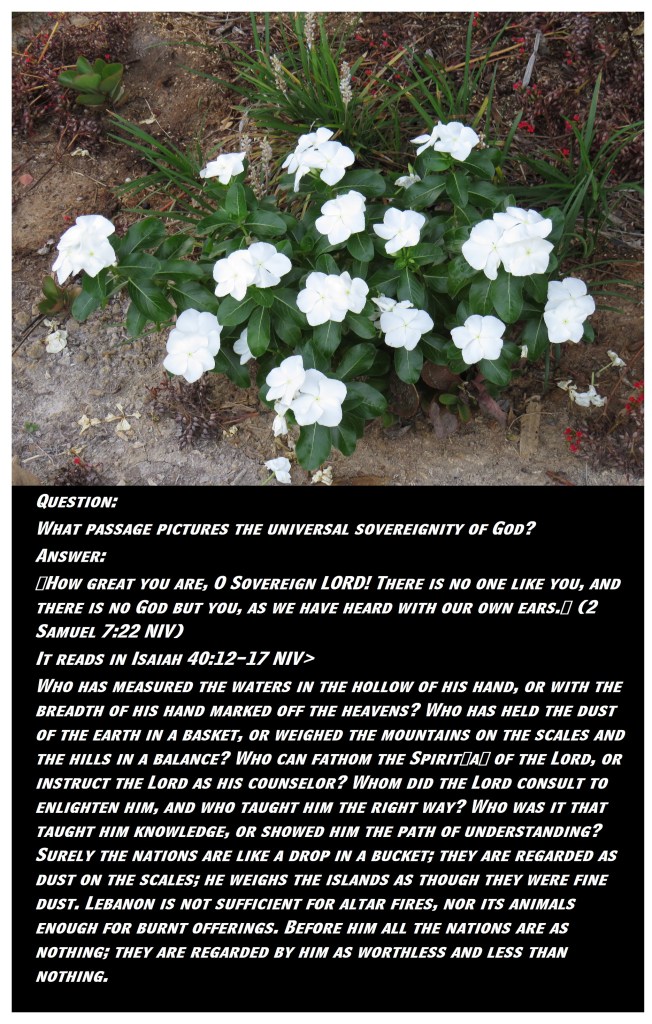
What passage pictures the universal sovereignty of God?
Answer:
“How great you are, O Sovereign LORD! There is no one like you, and there is no God but you, as we have heard with our own ears.”

(2 Samuel 7:22 NIV)

It reads in (Isaiah 40:12-17 NIV>)
Who has measured the waters in the hollow of his hand, or with the breadth of his hand marked off the heavens? Who has held the dust of the earth in a basket, or weighed the mountains on the scales and the hills in a balance? Who can fathom the Spirit of the Lord, or instruct the Lord as his counselor? Whom did the Lord consult to enlighten him, and who taught him the right way? Who was it that taught him knowledge, or showed him the path of understanding? Surely the nations are like a drop in a bucket; they are regarded as dust on the scales; he weighs the islands as though they were fine dust. Lebanon is not sufficient for altar fires, nor its animals enough for burnt offerings. Before him all the nations are as nothing; they are regarded by him as worthless and less than nothing.

“Question & Answer”

Question:
What passage, descriptive of the homeward way of the exiled Jewish community, has often been cited as describing humanity’s way of the future?
Answer:
And a highway shall be there, and a way, and it shall be called The way of holiness; the unclean shall not pass over it; but it shall be for those: the wayfaring men, though fools, shall not err therein.
Isaiah 35:8 KJV

“Question & Answer”

Question:
What passage gives a vivid picture of life in a desert country?
Answer;
It reads in Isaiah 32:2 NIV> Each one will be like a shelter from the wind and a refuge from the storm, like streams of water in the desert and the shadow of a great rock in a thirsty land.

“Question & Answer”

Question:
What illustration from the life of his own time does the author use to suggest that, although God does not always act in the same way, he always acts in the same way, he always acts with purpose?
Answer.
Of this, the “rules of good husbandry” are a parable. It reads in Isaiah 28:24-29 NIV> When a farmer plows for planting, does he plow continually? Does he keep on breaking up and working the soil? When he has leveled the surface, does he not sow caraway and scatter cumin? Does he not plant wheat in its place, barley in its plot, and spelt in its field? His God instructs him and teaches him the right way. Caraway is not threshed with a sledge, nor is the wheel of a cart rolled over cumin; caraway is beaten out with a rod, and cumin with a stick. Grain must be ground to make bread; so one does not go on threshing it forever. The wheels of a threshing cart may be rolled over it, but one does not use horses to grind grain. All this also comes from the LORD Almighty, whose plan is wonderful, whose wisdom is magnificent.