
Futility [ˌfyo͞oˈtilədē] NOUN pointlessness or uselessness.
Ecclesiastes is a book in the Old Testament of the Bible. It is described as “the words of the Philosopher, David’s son, who was King in Jerusalem” (verse 1). This is probably Solomon. The book talks about the meaning of life and the best way to live. People disagree about what the Book of Ecclesiastes means. Like the other books of wisdom in the Bible, Ecclesiastes is concerned with imparting wisdom and teaching all to fear the Lord. However, it serves as a balance for the practical wisdom of Proverbs. Although Ecclesiastes finds practical wisdom. Ecclesiastes Chapter 1 In the Israelite’s historical books of 1 Kings and 2 Chronicles, the documents claim that Solomon, King of Israel was granted one request by God himself. Solomon asked for wisdom rather than riches, power, or glory.
Why is Ecclesiastes important?
Some Bible teaches have said Ecclesiastes give a cynical view of life that teaches everything is worthless. Some have said Ecclesiastes is a call to enjoy life to its fullest because everything comes from God. Some have said Ecclesiastes is an exploration of the failure of human wisdom. Beneficial, it comes to it along a reflective path.
Who wrote Ecclesiastes and what does it mean?
The book of Ecclesiastes, along with Proverbs and the Song of Solomon, were written by Solomon, a man known for his own wisdom. For some background about the wisdom and knowledge of Solomon, { let’s read 1 Kings 3:5-12: At Gibeon the LORD appeared to Solomon during the night in a dream, and God said, “Ask for whatever you want me to give you.” Solomon answered, “You have shown great kindness to your servant, my father David, because he was faithful to you and righteous and upright in heart. You have continued this great kindness to him and have given him a son to sit on his throne this very day. “Now, LORD my God, you have made your servant king in place of my father David. But I am only a little child and do not know how to carry out my duties. Your servant is here among the people you have chosen, a great people, too numerous to count or number. So give your servant a discerning heart to govern your people and to distinguish between right and wrong. For who is able to govern this great people of yours?” The LORD was pleased that Solomon had asked for this. So God said to him, “Since you have asked for this and not for long life or wealth for yourself, nor have asked for the death of your enemies but for discernment in administering justice, I will do what you have asked. I will give you a wise and discerning heart, so that there will never have been anyone like you, nor will there ever be.}Solomon’s reign was a golden age for the nation of Israel. They were respected by their neighbors, residing in peace for the entirety of Solomon’s kingship. It was also a good time economically, with many nations bringing Solomon tribute and commerce. Solomon married the daughter of the Pharaoh in Egypt to cement his rule.
Let’s read; 2 Chronicles 1:9-15 Now, LORD God, let your promise to my father David be confirmed, for you have made me king over a people who are as numerous as the dust of the earth. Give me wisdom and knowledge, that I may lead this people, for who is able to govern this great people of yours?” God said to Solomon, “Since this is your heart’s desire and you have not asked for wealth, possessions or honor, nor for the death of your enemies, and since you have not asked for a long life but for wisdom and knowledge to govern my people over whom I have made you king, therefore wisdom and knowledge will be given you. And I will also give you wealth, possessions and honor, such as no king who was before you ever had and none after you will have.” Then Solomon went to Jerusalem from the high place at Gibeon, from before the tent of meeting. And he reigned over Israel. Solomon accumulated chariots and horses; he had fourteen hundred chariots and twelve thousand horses, which he kept in the chariot cities and also with him in Jerusalem. The king made silver and gold as common in Jerusalem as stones, and cedar as plentiful as sycamore-fig trees in the foothills.
The second book of Chronicles continues on from the first book without transition; originally they formed a single account in the Hebrew manuscripts. We have previously remarked the same thing in the second book of Kings about these artificial divisions which are not part of the inspired Word. In fact, the account of the Chronicles is a continuous one until the end of Solomon’s reign (2 Chronicles Chapter 10), and if we are looking for a moral division in our subject, it will not properly be introduced until 2 Chronicles Chapter 11. feel free to read these chapters on your own. Let us recall a truth, already mentioned many times in First Chronicles: in Chronicles God gives us, in the form of types, an overview of His counsels concerning Christ’s royalty, counsels prefigured in the history of David and Solomon. Solomon himself symbolizes the future reign of wisdom and peace that will be inaugurated by the Lord’s coming. This is why, as we have noted in 1 Chronicles in the history of David, Solomon’s reign does not present any failures in Chronicles and even with the greatest carefulness, one cannot discover there the least allusion to the king’s faults.
In the preceding book we have seen how Solomon was elevated to his father’s throne before he was established on his own throne. These two facts speak very clearly to us of Christ’s present heavenly kingdom and of His earthly kingdom which is yet to come. The account before us will present this latter to us, and here we will not find, as in Kings, a responsible and fallible sovereign, but rather the most perfect figure possible of a government of wisdom and of peace administered by the king according to the counsels of God.
Ecclesiastes Chapter 1:1-18
The words of Ecclesiastes, the son of David, king of Jerusalem. Vanity of vanities, said Ecclesiastes vanity of vanities, and all is vanity. What hath a man more of all his labor, that he taketh under the sun? One generation passes away, and another generation cometh: but the earth stands for ever. The sun rises, and goes down, and returned to his place: and there rising again, Makes his round by the south, and turned again to the north: the spirit goes forward surveying all places round about, and returns to his circuits. All the rivers run into the sea, yet the sea doth not overflow: unto the place from whence the rivers come, they return, to flow again. All things are hard: man cannot explain them by word. The eye is not filled with seeing, neither is the ear filled with hearing. What is it that hath been? the same thing that shall be. What is it that hath been done? the same that shall be done. Nothing under the sun is new, neither is any man able to say: Behold this is new: for it hath already gone before in the ages that were before us. There is no remembrance of former things: nor indeed of those things which hereafter are to come, shall there be any remembrance with them that shall be in the latter end. I Ecclesiastes was king over Israel in Jerusalem, And I proposed in my mind to seek and search out wisely concerning all things that are done under the sun. This painful occupation hath God given to the children of men, to be exercised therein. I have seen all things that are done under the sun, and behold all is vanity, and vexation of spirit. The perverse are hard to be corrected, and the number of fools is infinite. I have spoken in my heart, saying: Behold I am become great, and have gone beyond all in wisdom, that were before me in Jerusalem: and my mind hath contemplated many things wisely, and I have learned. And I have given my heart to know prudence, and learning, and errors, and folly: and I have perceived that in these also there was labor, and vexation of spirit, Because In much wisdom there is much indignation: and he that adds knowledge, adds also labor.
{Let’s Pray}
Father God, I thank You and praise You for this honest evaluation of living life in this fallen world, without Christ. Keep us from chasing after any of the vain things that this world offers, knowing that there is nothing on earth that has lasting value except to know You and the Lord Jesus Christ, my redeemer. I place You in the center of my life knowing that the whole duty and delight of man is to worship and praise You for Your goodness, forgiveness and grace to us and to all men. You give 2nd chances to walk with You. I thank You and praise You for the lessons we can learn from the life of Solomon and his judicious request for wisdom and knowledge. Give me the discernment to know Your will and to pray unto all that honor Your name. I thank You and praise You that You have promised to provide all that I need for life, godliness and keep me, I believe, from being enticed by the things of this world. Keep guiding me to keep the eyes of my faith on Jesus and in His Precious Name Amen.
{Power Verse}
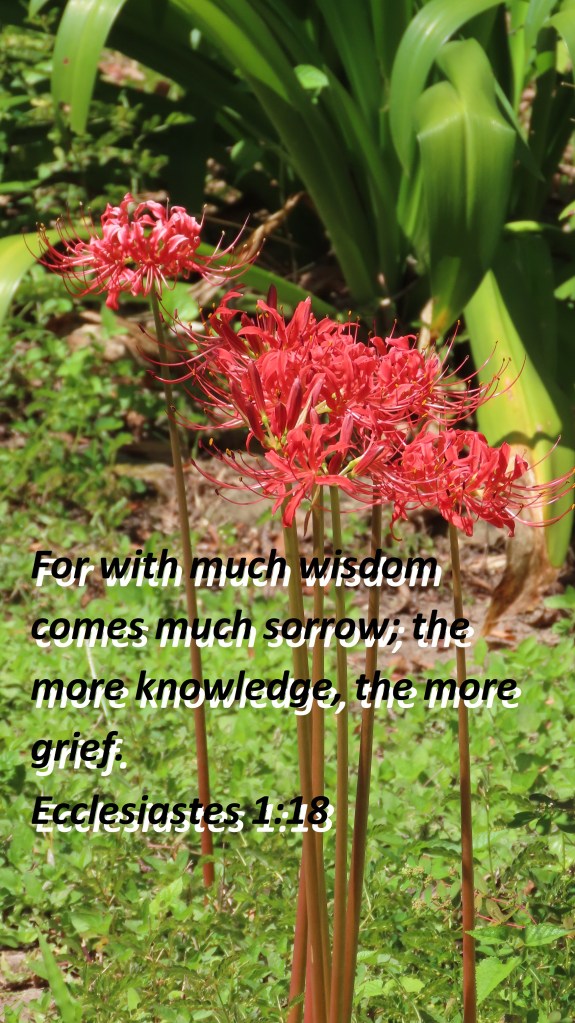
For with much wisdom comes much sorrow; the more knowledge, the more grief.
Ecclesiastes 1:18
 "Only Life Changes"